






I-CAR Repairability Technical Support Portal
my I-CAR Login
Close
Educational Programs
Academy
Academy for Shops
Academy for Schools
Courses
Course Catalog
Coming Soon
Types of Training
Learning Paths
ADAS Technician
Auto Physical Damage Appraiser
Electrical/Diagnostics Technician
Estimator
Mechanical Technician
Non-Structural Technician
Production Management
Refinish Technician
Structural Technician
Programs
Hands-On Skills Development
In-Shop Knowledge Assessment
Industry Training Alliance
Vehicle and Technology Specific Training
Welding Training & Certification
Registered Apprenticeship
Subscriptions
Value of Training
Network Programs
Insurance
OEM
Technical Information & Services
Repairability Technical Support Portal
Quick Search By Vehicle
OEM Information
Collision Repair News
OEM Calibration Requirements Search
OEM Partial Part Replacement Search
OEM Restraints System Part Replacement Search
OEM Hybrid & Electric Vehicle Disable Search
OEM Glass Replacement
I-CAR Best Practices
Just In Time
Ask I-CAR
ADAS Resources
Electric Vehicle Resources
In-Shop Knowledge Assessment Resources
Welding Resources
Repairers Realm
Collision Reporter
I-CAR Recognition
Platinum
Gold Class
Collision Repair Standards
Insurance Standards
Shop Locator
Industry Segments
Career & Technical Schools
Academy for Schools
PDP-EE - Training For My School
PDP-EE - Welding
PDP-EE - Users List
PDP-EE - Enhanced Package
PDP-EE - Pricing
PDP-EE - Resources and Forms
PDP-EE - Educator Role
PDP-EE - Blog
PDP-EE - my I-CAR
Instructor Support Website
Collision Repair Manager
Collision Repair Technician
Insurance APDA
Insurance Manager
OEM
Suppliers
Supporting Services
About I-CAR
About I-CAR
Vision, Mission & Core Beliefs & Values
Careers
Culture
Governance
Board of Directors
Industry Councils
Industry Reinvestment
Leadership
Membership
Industry Protocol
Sustaining Partners
Volunteers & Instructors
Instructors & Assessors
Volunteers & Committees
Collaborative Solutions
Collision Repair Education Foundation
Awards
MENU
  • Quick Search By Vehicle
  • OEM Information
  • Collision Repair News
  • OEM Calibration Requirements Search
  • OEM Partial Part Replacement Search
  • OEM Restraints System Part Replacement Search
  • OEM Hybrid And Electric Vehicle Disable Search
  • OEM Glass Replacement
  • I-CAR Best Practices
  • Just In Time
  • Ask I-CAR
  • Burnette
  • Babino
  • VanHulle
  • Team
  • Butler
Submit a new collision repair question here!

Follow us on @Ask_ICAR for daily updates.

  1. Home
  2. Collision Repair News
  3. Repair or Replace? – Material Tensile Strength Key to Repairability

Repair or Replace? – Material Tensile Strength Key to Repairability

Posted on: 23 September 2014
Share:
Print Print
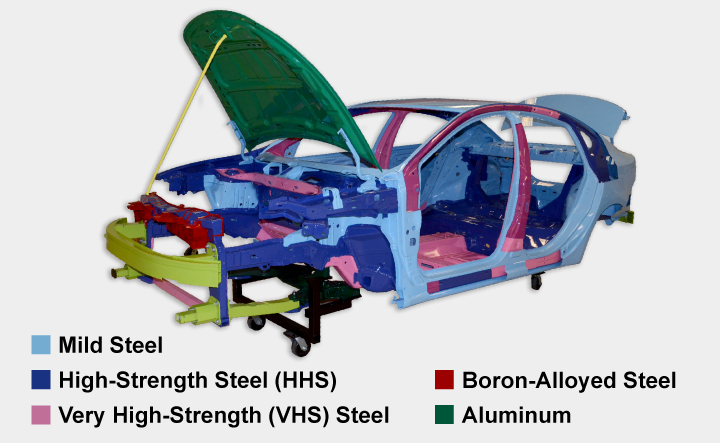
Courtesy of Chrysler Group LLC

Repair or Replace? – Material Tensile Strength Key to Repairability

Jason Bartanen, I-CAR Director, Industry Technical Relations

The world of steels continues to evolve at a rapid pace and repair professionals need to keep up. In order to perform complete, safe, and quality repairs, it’s imperative to identify the type of material we’re working with, to know what is repairable, and know which options we have for part replacement when straightening is not an option.

20 Years in the Making
In recent years, auto manufacturers have been tasked with reducing vehicle weight, while making vehicles safer (added weight) and still providing all of the entertainment (added weight) and information systems (added weight) that today’s consumers demand. These opposing forces have required auto manufacturers to modify their approach to vehicle construction. For the past two decades, most of the modified approaches have been linked to different types of steels. For many years, the majority of vehicles were constructed of mainly mild steel, with some high‑strength steel (HSS) used on occasion, and ultra‑high‑strength steel (UHSS) used for a number of door intrusion beams and bumper reinforcements. But that started to change, 20 years ago.

(In broad terms, mild steels typically fall in the range up to 210 MPa; HSS between 210–600 MPa; and UHSS, anything above 600 MPa. (1 MPa is equal to 145 psi; therefore, 600 MPa would equal 87,020 psi). These numbers do vary from OEM to OEM, but generally speaking, these are common ranges.)

In 1994, a number of steel manufacturers (35, to be exact) started on a mission to “demonstrate a lightweight steel auto body structure that would meet a wide range of safety and performance targets.” The result of that collaborative effort was the UltraLight Steel Auto Body (ULSAB) vehicle – a vehicle structure that weighed up‑to 36% less than a vehicle of similar size, but constructed with common (at the time) types of steel. This work led to many of the Advanced High‑Strength Steels (AHSS) found on today’s vehicles.

The ULSAB was built using more than 90% HSS and UHSS, and was the dawn of the automotive industry hearing terms such as:

  • Dual‑phase (DP)
  • Transformation Inducted Plasticity (TRIP)
  • Complex Phase (CP)
  • Boron
  • Hot Stamped and Hot Formed
  • Martensitic
  • Hydroforming
  • Tailored blanks
  • Laser welding

While these terms are more widely known today, their meanings aren’t always clear, and often add an additional layer of complexity to “repair vs. replace” decisions taking place, on a daily basis, in collision repair facilities nationwide.

What is important to know, from a repairability standpoint, isn’t necessarily the type of steel (DP, TRIP, CP, etc.), or manufacturing process (tailored blanks, hydroforming, and hot-stamping), but the tensile strength of the material (DP600, DP800, DP1000, etc.). The tensile strength of the materials is what enables collision repair professionals to determine if a part can be straightened, or if it requires replacement; and if it requires replacement, it often dictates the attachment method(s) allowable (sometimes, required) to repair today’s late‑model vehicles.

AHSS Repairability
Just because a part is made of AHSS, doesn’t necessarily mean it can’t be straightened. Some vehicle makers offer repairability guidelines, based on the type and tensile strength of the steel. While lower‑tensile‑strength steels tend to offer more opportunities for straightening, some automakers allow cold straightening up to 700 Megapascals (MPa). OEMs including GM, Ford, Chrysler, Toyota, and Honda provide guidelines on the types of materials that can be straightened, and whether or not heat can be used for straightening. High‑strength steels are more prone to losing strength than mild steel when heat is used for straightening. Ultra‑high‑strength steels are extremely heat sensitive and will lose their strength if heat is applied, for straightening. Always follow the vehicle maker’s guidelines for the use of heat.

A guideline that has historically been used to make repair vs. replacement decision is the I‑CAR® Kink vs. Bend Rule. Simply stated, bent parts were often repairable and kinked parts required replacement. The former definition of a kink was “a sharp bend with a small radius over a short distance. A part is considered kinked if, after straightening, there is a permanent area of deformation, which will not return to its original state and shape without the use of excessive heat. Kinked parts may also have visible cracks or tears in the metal.” It’s important to restore both the shape and the state of the part. If either of these is incomplete, following straightening, the part should be considered kinked and should be replaced.

The kink vs. bend rule is no longer as simple as it sounds. A part may not look like it is kinked, but it may not be able to be straightened without damaging the grain structure, if it isn’t already damaged by the collision. The damage may be in the form of micro-cracking which is not easy to see. In more extreme cases, cracking may occur during straightening which is easier to see, and will require part replacement.

The stronger the steel, the less repairable it becomes. For example, attempting to straighten a slight bend in a UHSS part may cause it to crack, if it is able to be straightened at all. When steel in the 600–800 MPa range must be straightened, as a best practice, a dye penetrant should be used to ensure no micro-cracking has occurred in the steel. Some vehicle makers do not recommend straightening UHSS parts that are above 600 MPa due to the potential of cracking and tearing the part, and the possible damage structural pulling can do to adjacent panels and other parts of the vehicle structure.

If the part is bent, but the thickness or strength of the metal will not allow for straightening without leaving an area of permanent deformation, then replacement, either partial or complete, would be appropriate.

Identification
Because repairability is often dependent on the type of steel used, it’s critical to know the strength of a part when making repair decisions. There are a number of options that can be used to identify the strength of steel found in today’s vehicles.

The first, and most reliable, is referring to the vehicle maker’s body repair manual. Many OEMs are doing a great job of clearly identifying the construction materials used in their vehicles. This information, coupled with OEM repairability guidelines, is the most effective way to determine what can be repaired and what requires replacement.

Another dependable way to identify the strength of a part is to use strength identification equipment. The GYSTEEL VISION is one tool that can be used to identify steel strength. After cleaning the steel (two‑sided access is required), the VISION is attached to the steel part and tightened in place. A measuring pen is then used to take a reading of the steel. The number on the pen is compared to a chart provided by the tool maker to identify the strength of the steel.

Another option, although significantly less reliable than the aforementioned options, would be to attempt to identify the steel, based on its location on the vehicle. All vehicles are built with the consideration of collision energy management. The front, and rear of the vehicle is designed to collapse in a collision, and the center section, around the passenger compartment, is designed remain intact, protecting the occupants, so it transfers the collision energy rather than absorbing it, as collapse zones of the vehicle do. Using this “logic,” it is reasonable to believe that those steels found in the front and rear may have less strength than those on the side of the vehicle; especially reinforcements in the A‑ and B‑pillars, rocker panels, and roof rails.

However, this logic isn’t always accurate, as General Motors is now employing 700 MPa material in the front, lower rails on some of their vehicles – for example, the Cadillac ATS. Considering that the design trend is for steels to become increasingly thinner to save weight, they will need to become stronger as well. Because of that, if any assumption is made as to an unknown type of steel used on a side structure of a vehicle being repaired, it should be that the parts are UHSS. The outer panels may be relatively softer steels to allow easier forming, but even outer panel strengths are increasing as panel thickness is being reduced for weight savings.

Partial Part Replacement
If a part requires replacement, it does not always require complete replacement. A number of vehicle makers allow for partial replacement at factory seams, or for sectioning those parts.

Partial replacement of an assembly at factory seems is an approach that vehicle makers, such as Honda, have taken. For example, the lower rail on a late‑model Accord is serviced as a complete assembly, including a portion of the rail that attaches under the passenger compartment. If the damage is confined to an area forward of the cowl, Honda allows that assembly to be dismantled, just forward of the cowl, and installed. This creates a less intrusive repair, by allowing OEM spot welds, under the passenger compartment, to remain intact and leaves OEM corrosion protection undisturbed. Not all vehicle makers allow this type of procedure, so it’s important, as always, to refer to the vehicle maker procedures. If there are no recommendations from the vehicle maker for, or against, this type of procedure, collision professionals must carefully weigh the advantages before making the decision to move forward with this type of repair.

Other vehicle makers offer a variety of sectioning procedures for many of their structural parts. Unlike partial replacement of an assembly at a factory seam, sectioning allows the technician to replace a portion of a part by marking and cutting the part at a vehicle maker identified sectioning location. Some vehicle makers offer multiple locations, within a single part, for sectioning; others offer only one location. Sectioning should only be done in locations identified by the vehicle maker. The joint configuration of the sectioning location should also be determined, based on the vehicle maker procedures.

In the late 1980s, I‑CAR developed general sectioning guidelines that were used by industry professionals for many years. These general sectioning guidelines are no longer applicable on late model vehicles. For a complete recap of those general sectioning guidelines, visit the I‑CAR Repairability Technical Support (RTS) portal. The article can be found at: Update: Are General Sectioning Guidelines Still Applicable?

In the next I‑CAR article, we’ll take a closer look at the attachment methods for installing parts

Rapid Changes Requires Rethinking
We are in the midst of a “technical tsunami” with the rapid advancements in vehicles, including the world of steels. Repair professionals need to keep up to date with the latest changes in technology, materials, processes and training. The old way of repairing or replacing is not necessarily the right way to perform complete, safe and quality repairs of today’s complex vehicles. It is crucial to accurately identify the vehicle material and determine what is repairable versus replaceable, and to know your options.

The I-CAR Welding Training & Certification program includes instruction on welding theory, a hands-on evaluation by the Instructor of the facility’s gear, equipment, and infrastructure prior to the in-shop training, practice, and the industry-recognized certification test. More information on all of I-CAR’s welding courses (steel GMA welding, aluminum GMA (MIG) welding, and Steel sectioning) can be found at www.i-car.com. As part of I-CAR’s commitment to the industry, pricing for welding training has been reduced to make it more affordable for every technician to have the hands-on training needed to complete a proper weld.

A growing number of OEMs use I-CAR Welding Training & Certification in their network programs, including Acura, Audi, Chrysler, Ford, GM, Honda, Infiniti, Jaguar, Land Rover, Lexus, Nissan, Porsche, Scion, Toyota, Volvo and Volkswagen. In addition, businesses that achieve Gold Class, the industry standard for collision repair training, also include welding training as a program requirement.

Whether it’s steel, aluminum, other vehicle construction materials, or a combination of materials, it’s important that you equip your facility with the proper tools, equipment, and training to allow for complete, safe, and quality repairs. These investments can lead to increased profitability, improved operational efficiency and productivity, and higher customer satisfaction and retention levels.

Jason Bartanen is the I-CAR Director of Industry Technical Relations and is responsible for the I-CAR Repairability Technical Support initiative, at the I-CAR Tech Center in Appleton, WI. He has over 25 in the collision repair industry, the last 18 with I-CAR. Prior to his current role, Bartanen served several roles at I-CAR; as an Instructional Designer, Technical Development Manager and most recently as the Technical Director. Bartanen also assists in managing I-CAR’s specialty training development and delivery programs for a number of vehicle manufactures. Bartanen is a member of the SkillsUSA Collision Repair Technology committee.

*Used with the permission of Fixed Ops Magazine

Additional I-CAR Collision Repair News you may find helpful:

  • Welding And MIG Brazing Hotspot

Related I-CAR Courses

Course Advanced High-Strength Steel

Course Welding Training and Certification

  • Most Popular
  • Most Recent
  • Archive
  • Toyota/Lexus/Scion Position Statement: Pre- and Post-Repair System Scanning Thursday, 28 July 2016

    As the industry continues to ask if pre- and post-repair system scanning is necessary, Toyota/Lexus/Scion provides their answer.

  • Pre- and Post-Repair System Scanning Statements Wednesday, 9 January 2019

    Are you wondering if a particular OEM or organization has a published statement on pre-repair and post-repair scanning? We have compiled a list of most of the statements on the subject, so you can...

  • ADAS, Calibration, And Scanning Article Hotspot Monday, 14 January 2019

    Since advanced driver assistance systems (ADAS), scanning, and calibration first started becoming relevant, members of the collision repair industry have required as much knowledge as possible on...

  • Honda/Acura Position Statement: Pre- and Post-Repair System Scanning - UPDATE Wednesday, 22 May 2019

    Honda /Acura has updated their position statement on pre- and post-repair scanning to give more clarification on what is expected for scanning.

  • BMW Position Statement: Pre- and Post-Repair System Scanning - UPDATE Friday, 10 April 2020

    BMW has released a position statement related to pre- and post-repair system scanning. The statement applies to All vehicles equipped with on board diagnostics II (OBD II).

  • Quickly Identifying Outer Quarter Panels w/Rolled Hem Flanges Monday, 5 March 2018

    The I-CAR best practice article, Recycled Outer Quarter Panels w/Rolled Hem Flanges has gotten a lot of interest from the collision repair industry. It’s important to know which vehicles are...

  • General Motors Position Statement: Pre- and Post-Repair System Scanning Friday, 21 October 2016

    As the industry continues to ask, are pre- and post-repair scans necessary, General Motors provides their answer.

  • Restraints Wiring Repairs Monday, 23 May 2016

    Over the past few months, we've been sharing OEM position statements on restraints wiring repairs. Now we're bringing them all together in one place for easy reference.

  • FCA/Stellantis Position Statement: Pre- and Post-Repair System Scanning Thursday, 9 June 2016

    FCA/Stellantis has released a position statement related to pre- and post-repair system scanning.

  • Nissan/INFINITI Position Statement: Pre- and Post-Repair System Scanning - UPDATE Monday, 14 January 2019

    Nissan/INFINITI updated their position statement on pre- and post-repair scanning. The revised position statement touches on more subjects and gives additional information on the subject.

  • Repairer Driven News: Rivian Updates Door Handle Procedure Sunday, 4 February 2035

    Repairer Driven News (RDN) released an article featuring an updated Rivian procedure.

  • Body Construction And Material Repair Guidelines: Toyota/Lexus - UPDATE Tuesday, 30 September 2025

    What is the MPa of the front lower rail? What is the outer uniside made of: steel, aluminum, or composite? Can heat be used to straighten or is it cold straightening only? What are the repair...

  • I-CAR Repairers Realm: Ford Explorer Rear Rail Sectioning - Now Available Friday, 26 September 2025

    I-CAR had a discussion on 2020-2025 Ford Explorer rear rail sectioning.

  • Digital Key Considerations: FCA/Stellantis Wednesday, 24 September 2025

    The intermingling of technology and automobiles continues, with digital key offerings from most vehicle makers. Digital keys utilize smartphone technology to expand vehicle access and owner...

  • App-Based Connected Services Considerations: FCA/Stellantis Wednesday, 24 September 2025

    Have you had an experience where the vehicle notified the owner that it was being moved while it was in your repair facility? App-based connected services are available from many vehicle makers and...

  • Backup Battery And Low-Voltage Disconnect: Mazda Friday, 19 September 2025

    When an accident happens, how will you call for help? Maybe the telematics system, equipped with a backup battery, could automatically do this, even if the main power is cut off. What are the repair...

  • Body Repair Manual Symbols: Kia Wednesday, 17 September 2025

    While looking at repair procedures in a body repair manual (BRM) you may notice that symbols are used to indicate specific operations or parts to be used during the repair process. Most BRMs provide a...

  • I-CAR Just In Time: Mirror Matching Parts Monday, 15 September 2025

    Sometimes seeing is understanding, that’s why I-CAR's technical team created the Just in Time video series to guide you through a variety of collision repair topics from ADAS and EVs to repair tips...

  • I-CAR Just In Time: Blend Panel Prep And Toner Replacement Wednesday, 10 September 2025

    Sometimes seeing is understanding, that’s why I-CAR's technical team created the Just in Time video series to guide you through a variety of collision repair topics from ADAS and EVs to repair tips...

  • GM Repair Insights: Summer 2025 Monday, 8 September 2025

    The summer edition of General Motors (GM) Repair Insights is now available.

  • February 2023
    • 2007 Chevrolet Silverado 1500 (New)
    • 2007 Chevrolet Silverado 1500 Classic
    • 2007 Chevrolet Silverado 1500 HD Classic
    • 2007 Chevrolet Silverado 2500 HD
    • 2007 Chevrolet Silverado 2500 HD Classic
    • 2007 Chevrolet Silverado 3500 Classic
    • 2007 Chevrolet Silverado 3500 HD
  • January 2019
    • 2007 Chevrolet Silverado 1500 Classic Parallel Hybrid Truck (PHT)
  • May 2015
    • 2007 Audi A3
    • 2007 Audi A4
    • 2007 Audi A4 Cabriolet
    • 2007 Audi A6
    • 2007 Audi A8
    • 2007 Audi Q7
    • 2007 Audi TT
  • December 2014
    • 2007 Chevrolet Silverado 1500 Classic Parallel Hybrid Truck (PHT)
  • September 2014
    • 2007 Acura CSX
    • 2007 Acura MDX
    • 2007 Acura RDX
    • 2007 Acura RL
    • 2007 Acura TL
    • 2007 Acura TSX
    • 2007 Audi A3
    • 2007 Audi A4/S4 Convertible
    • 2007 Audi A4/S4 Sedan/Wagon
    • 2007 Audi A6 Sedan
    • 2007 Audi A6 Wagon
    • 2007 Audi A8/A8L 4.2L V8
    • 2007 Audi A8L 6.0L W12/ S8
    • 2007 Audi Q7
    • 2007 Audi RS4 Sedan
    • 2007 Audi S6 Sedan
    • 2007 BMW 3-Series Convertible
    • 2007 BMW 3-Series Coupe
    • 2007 BMW 3-Series Sedan
    • 2007 BMW 3-Series Wagon
    • 2007 BMW 5-Series Sedan
    • 2007 BMW 5-Series Wagon
    • 2007 BMW 6 Series Convertible
    • 2007 BMW 6 Series Coupe
    • 2007 BMW 7 Series
    • 2007 BMW X3
    • 2007 BMW X5 3.0i/3.0is/4.8i
    • 2007 BMW Z4
    • 2007 Buick LaCrosse (USA)/ Allure (Canada)
    • 2007 Buick Lucerne
    • 2007 Buick Rainier
    • 2007 Buick Rendezvous
    • 2007 Buick Terraza
    • 2007 Cadillac CTS
    • 2007 Cadillac DTS
    • 2007 Cadillac Escalade
    • 2007 Cadillac Escalade EXT
    • 2007 Cadillac SRX
    • 2007 Cadillac STS
    • 2007 Cadillac XLR
    • 2007 Chevrolet Avalanche
    • 2007 Chevrolet Aveo Hatchback
    • 2007 Chevrolet Aveo Sedan
    • 2007 Chevrolet Cobalt
    • 2007 Chevrolet Colorado Ext/Crew Cab
    • 2007 Chevrolet Colorado Std Cab
    • 2007 Chevrolet Corvette
    • 2007 Chevrolet Equinox
    • 2007 Chevrolet Express
    • 2007 Chevrolet Express Cutaway
    • 2007 Chevrolet HHR
    • 2007 Chevrolet Impala/Impala Limited
    • 2007 Chevrolet Malibu Maxx
    • 2007 Chevrolet Malibu\Classic
    • 2007 Chevrolet Monte Carlo
    • 2007 Chevrolet Silverado 1500 Crew Cab
    • 2007 Chevrolet Silverado 1500 Std/Ext Cab
    • 2007 Chevrolet Silverado 2500HD/3500 Crew Cab
    • 2007 Chevrolet Silverado 2500HD/3500 Crew Cab
    • 2007 Chevrolet Silverado 2500HD/3500 Std/Ext Cab
    • 2007 Chevrolet Silverado 2500HD/3500 Std/Ext Cab
    • 2007 Chevrolet Silverado 3500 Std/Ext Cab&Chassis
    • 2007 Chevrolet Silverado Crew Cab
    • 2007 Chevrolet Silverado Hybrid
    • 2007 Chevrolet Silverado Std/Club Cab
    • 2007 Chevrolet Suburban
    • 2007 Chevrolet Tahoe
    • 2007 Chevrolet Trailblazer
    • 2007 Chevrolet Uplander
    • 2007 Chrysler 300/300C
    • 2007 Chrysler Aspen
    • 2007 Chrysler Crossfire
    • 2007 Chrysler Pacifica
    • 2007 Chrysler PT Cruiser Convertible
    • 2007 Chrysler PT Cruiser Hatchback
    • 2007 Chrysler Sebring/200 Sedan
    • 2007 Chrysler Town & Country
    • 2007 Dodge Caliber
    • 2007 Dodge Caravan
  • June 2014
    • 2007 Acura MDX
    • 2007 Acura RDX
    • 2007 Acura RL
    • 2007 Acura TL
    • 2007 Acura TSX
    • 2007 BMW 3 Series
    • 2007 BMW 5 Series
    • 2007 BMW 6 Series
    • 2007 BMW 7 Series
    • 2007 BMW X3
    • 2007 BMW X5
    • 2007 BMW Z4
    • 2007 Buick LaCrosse
    • 2007 Buick Lucerne
    • 2007 Buick Rainier
    • 2007 Buick Rendezvous
    • 2007 Buick Terraza
    • 2007 Buick Terraza Ext.
    • 2007 Cadillac CTS
    • 2007 Cadillac DTS
    • 2007 Cadillac Escalade
    • 2007 Cadillac Escalade ESV
    • 2007 Cadillac Escalade EXT
    • 2007 Cadillac SRX
    • 2007 Cadillac STS
    • 2007 Cadillac XLR
    • 2007 Chevrolet Avalanche
    • 2007 Chevrolet Aveo
    • 2007 Chevrolet Cobalt Coupe
    • 2007 Chevrolet Cobalt Sedan
    • 2007 Chevrolet Colorado
    • 2007 Chevrolet Corvette Convertible
    • 2007 Chevrolet Corvette Coupe
    • 2007 Chevrolet Corvette Z06
    • 2007 Chevrolet Equinox
    • 2007 Chevrolet Express
    • 2007 Chevrolet HHR
    • 2007 Chevrolet Impala
    • 2007 Chevrolet Malibu
    • 2007 Chevrolet Malibu Maxx
    • 2007 Chevrolet Monte Carlo
    • 2007 Chevrolet Suburban
    • 2007 Chevrolet Tahoe
    • 2007 Chevrolet TrailBlazer
    • 2007 Chevrolet Uplander
    • 2007 Chevrolet Uplander Ext.
    • 2007 Chrysler 300
    • 2007 Chrysler Aspen
    • 2007 Chrysler Crossfire
    • 2007 Chrysler Pacifica
    • 2007 Chrysler PT Cruiser
    • 2007 Chrysler Sebring
    • 2007 Chrysler Town & Country
    • 2007 Chrysler Voyager
    • 2007 Dodge Caliber

Top Ten Vehicle Specific Questions

  • Hyundai Does Hyundai have a sectioning procedure available?
  • 2014 Jeep Cherokee Is there a procedure available for resetting the active headrestt?
  • Kia Does Kia have a sectioning procedure available?
  • Chevrolet Does Chevrolet have a warning against sectioning when there is no procedure?
  • BMW Can I-CAR send me BMW repair procedures?
  • Hyundai Does Hyundai have part replacement procedures available?
  • Honda What does Honda say about repairing damaged airbag system wiring harnesses?
  • Mercedes-Benz Can I-CAR send me Mercedes-Benz repair procedures?
  • Honda What does Honda say about straightening front lower rails?
  • Subaru Do you have to replace a front passenger airbag on a Subaru even if the airbag did not deploy? The repair information seems to indicate that it should.

Top Ten I-CAR Specific Questions

  • What does I-CAR say about using a recycled quarter panel assembly that includes the inner, outer, and reinforcements?
  • What does I-CAR say about repair tolerances?
  • What does I-CAR say about straightening a kink?
  • What does I-CAR say about replacing suspension parts in pairs?
  • What does I-CAR say about the decision to use recycled parts?
  • What does I-CAR say about repairing damaged door intrusion beams?
  • Can I-CAR General Sectioning Guidelines be used?
  • What does I-CAR say about repairing damaged bumper reinforcements?
  • What does I-CAR say about using recycled airbags?
  • What does I-CAR say about disconnecting the battery prior to welding on the vehicle, specifically in regards to airbags?
I-CAR Knowledge and Skills Protocol Collision Reporter Network Programs Industry Training Alliance BodyShopology
  • About RTS
  • Contact Us
  • Related Industry Links
  • Newsletter
  • Help/FAQ
  • Cancellation Policy
  • Ad and Cookie Policy
  • Updated Privacy Policy
  • Updated Terms and Conditions
Facebook LinkedIn Instagram Twitter YouTube Apple Podcasts
I-CAR Tech Center (RTS)
N127 South Park Drive
Appleton, WI 54914
Copyright © I-CAR. All rights reserved. WebCitz
Tweets by @Ask_ICAR