







I-CAR Repairability Technical Support Portal
my I-CAR Login
Close
Educational Programs
Academy
Academy for Shops
Academy for Schools
Courses
Course Catalog
Course Updates
Types of Training
Learning Paths
ADAS Technician
Auto Physical Damage Appraiser
Electrical/Diagnostics Technician
Estimator
Mechanical Technician
Non-Structural Technician
Production Management
Refinish Technician
Structural Technician
Programs
Hands-On Skills Development
In-Shop Knowledge Assessment
Industry Training Alliance
Vehicle and Technology Specific Training
Welding Training & Certification
Registered Apprenticeship
Subscriptions
Value of Training
Network Programs
Insurance
OEM
Technical Information & Services
Repairability Technical Support Portal
Quick Search By Vehicle
OEM Information
Collision Repair News
OEM Calibration Requirements Search
OEM Partial Part Replacement Search
OEM Restraints System Part Replacement Search
OEM Hybrid & Electric Vehicle Disable Search
OEM Glass Replacement
I-CAR Best Practices
Just In Time
Ask I-CAR
ADAS Resources
Electric Vehicle Resources
In-Shop Knowledge Assessment Resources
Welding Resources
Repairers Realm
Collision Reporter
I-CAR Recognition
Platinum
Gold Class
Collision Repair Standards
Insurance Standards
Shop Locator
Industry Segments
Career & Technical Schools
Academy for Schools
PDP-EE - Training For My School
PDP-EE - Welding
PDP-EE - Users List
PDP-EE - Enhanced Package
PDP-EE - Pricing
PDP-EE - Resources and Forms
PDP-EE - Educator Role
PDP-EE - Blog
PDP-EE - my I-CAR
Instructor Support Website
Collision Repair Manager
Collision Repair Technician
Insurance APDA
Insurance Manager
OEM
Suppliers
Supporting Services
About I-CAR
About I-CAR
Vision, Mission & Core Beliefs & Values
Careers
Culture
Governance
Board of Directors
Industry Councils
Industry Reinvestment
Leadership
Membership
Industry Protocol
Sustaining Partners
Volunteers & Instructors
Instructors & Assessors
Volunteers & Committees
Collaborative Solutions
Collision Repair Education Foundation
Awards
MENU
  • Quick Search By Vehicle
  • OEM Information
  • Collision Repair News
  • OEM Calibration Requirements Search
  • OEM Partial Part Replacement Search
  • OEM Restraints System Part Replacement Search
  • OEM Hybrid And Electric Vehicle Disable Search
  • OEM Glass Replacement
  • I-CAR Best Practices
  • Just In Time
  • Ask I-CAR
  • Team
  • Babino
  • Burnette
  • VanHulle
  • Butler
Submit a new collision repair question here!

Follow us on @Ask_ICAR for daily updates.

  1. Home
  2. Collision Repair News
  3. OSHA Hazard Communication Standard Revision

OSHA Hazard Communication Standard Revision

Posted on: 09 May 2013
Share:
Print Print

The Occupational Safety and Health Administration (OSHA) is requiring that all employees be trained, by December 1st of 2013, on the revision to its Hazard Communication Standard. The revision to the 1994 standard more closely aligns with the Globally Harmonized System (GHS), an international approach to labeling and classifying hazardous products.

Why the change? Credit the global marketplace. The U.S. is both a major importer and exporter of chemicals. American workers often see labels and material safety data sheets (MSDS) from the U.S. and from other countries. The diverse and sometimes conflicting national and international requirements can create confusion among those who seek to use hazardous material information effectively.

Major Changes
The Hazard Communication Standard regulates identification and communication of hazardous products in the workplace. The major changes include:

  • Hazard classification: There are now specific criteria for classification of health and physical hazards, to help ensure that evaluations of hazardous effects are consistent across product makers.
  • Labels: Chemical manufacturers and importers will be required to provide a label that includes the product name, supplier identification including an emergency phone number, the word "Warning" or "Danger," pictograms, and hazard statements for each hazard class and category. Precautionary statements must also be provided.

Safety Data Sheets: The word "Material" has been dropped, and there is a specified 16-section format. The previous standard had a nine-section material safety data sheet, but product makers could generally deviate from that as long as the information was there. Now all safety data sheets will be 16 sections.

If manufacturers, importers, distributors, or employers become newly aware of any significant information regarding the hazards of a chemical, the label should be revised to the new standard within six months of becoming aware of the new information. With products that have not changed, product makers have between June and December of 2015 to convert their labels and safety data sheets to the new standard.

Why the December 1st 2013 training requirement for employees if the product makers have until 2015 to implement the new standard requirements? OSHA believes that American workplaces will soon begin to receive labels and SDSs that are consistent with the GHS, since many American and foreign chemical manufacturers have already begun to produce GHS-compliant labels and SDSs. It's important to ensure that when employees begin to see the new labels and SDSs in their workplaces, they will be familiar with them, understand how to use them, and be able to access the information effectively.

Label Requirements
The supplier must provide at least the following on every hazardous material label:

  • The product identifier (name)
  • A signal word, indicating the relative level of severity of the hazard, either "Danger" (more severe) or "Warning" (less severe)
  • Hazard statements assigned to each applicable hazard class or category, such as "Flammable" or "Carcinogen"
  • Pictograms, eight to choose from and one environmental hazard option
  • Precautionary statements stating what should be done to protect the worker from the hazard, such as "Respiratory protection required" or "Keep away from open flame"
  • Name, address, and telephone number of the product maker or importer or other responsible party

The eight pictograms are shown below.
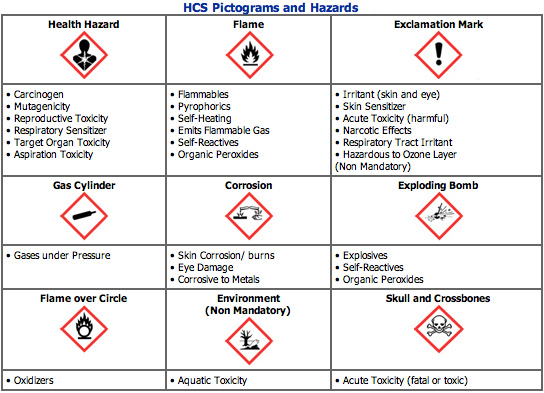
pictogramsOne or more of these pictograms must be on supplier labels.

Note that the pictograms are all within a red diamond. There are two new pictograms, one indicating "Health Hazard" and one indicating "Explosive." Health Hazards include carcinogens, reproductive toxins, and other toxins that target a specific organ. Explosives have been separated from flammables. The Environment pictogram is non-mandatory, as OSHA does not oversee environmental hazards.

Workplace Labels
Workplace labels are mentioned in the revised standard, but nothing has really changed. The minimum requirements for a workplace label are still the product name and indications on the specific hazards of the product, using pictograms, phrases, or words, whatever is available and applicable. If pictograms and phrases are used, they should be consistent with the revised standard. Sources for the label can be as complicated as using labeling kits from a safety catalog, or as simple as writing the information directly and legibly on the container in permanent marker.

National Fire Protection Association (NFPA) labels, with the diamond shape and the color and numbering system, can be used as workplace labels, but there's an important difference in the numbering system used by the NFPA compared to the GHS. With the NFPA system, the higher the number the greater the hazard, so a "1" is the least severe hazard. With the GHS, it's just the opposite, the lower the number the more severe the hazard, so a "1" is the most severe hazard. When using the NFPA label as a workplace label, use the GHS numbering system. The numbers are often included in the SDS.

Safety Data Sheet (SDS)
The information required on the SDS remains essentially the same as that in the 1994 standard, except that the information must be presented using 16 specific headings in a specified sequence.

The format of the 16-section SDS should include the following sections:

  • Section 1. Identification
  • Section 2. Hazard(s) identification
  • Section 3. Composition/information on ingredients
  • Section 4. First-Aid measures
  • Section 5. Fire-fighting measures
  • Section 6. Accidental release measures
  • Section 7. Handling and storage
  • Section 8. Exposure controls/personal protection
  • Section 9. Physical and chemical properties
  • Section 10. Stability and reactivity
  • Section 11. Toxicological information
  • Section 12. Ecological information
  • Section 13. Disposal considerations
  • Section 14. Transport information
  • Section 15. Regulatory information
  • Section 16. Other information, including date of preparation or last revision

Note that although the headings for Sections “12” “15” are mandatory, OSHA will not enforce the content of these four sections because these sections are within other agencies' jurisdictions.

Employer's Responsibility
Repair facility owners and managers need to become familiar with the standard revisions and train their employees on recognizing the new labels and reading the new SDS versions by December 1st.

OSHA has some downloadable "quick cards" available for help with this training. Go to www.osha.gov.

Besides the general information, it's even more important that repair facility owners and managers explain how the hazardous communication procedures will change in the specific facility. If OSHA makes a visit, that is what they will be looking for; if employees know how to find and read the information on hazardous materials that they work with.

Conclusion
OSHA recently updated its Hazard Communication Standard, which covers requirements for labels, safety data sheets, and hazard material classifications. Several product makers have already begun using the new labeling and SDS system, so, OSHA is requiring employees be trained to recognize the new label and SDS format by December 1st, 2013.

Even more important than general information is for shop owners and managers to inform employees about how hazard communications will change in the repair facility.


Related I-CAR Courses

Course Safety Data Sheets and Labels

Course Workplace Safety

  • Most Popular
  • Most Recent
  • Archive
  • Toyota/Lexus/Scion Position Statement: Pre- and Post-Repair System Scanning Thursday, 28 July 2016

    As the industry continues to ask if pre- and post-repair system scanning is necessary, Toyota/Lexus/Scion provides their answer.

  • Pre- and Post-Repair System Scanning Statements Wednesday, 9 January 2019

    Are you wondering if a particular OEM or organization has a published statement on pre-repair and post-repair scanning? We have compiled a list of most of the statements on the subject, so you can...

  • ADAS, Calibration, And Scanning Article Hotspot Monday, 14 January 2019

    Since advanced driver assistance systems (ADAS), scanning, and calibration first started becoming relevant, members of the collision repair industry have required as much knowledge as possible on...

  • Honda/Acura Position Statement: Pre- and Post-Repair System Scanning - UPDATE Wednesday, 22 May 2019

    Honda /Acura has updated their position statement on pre- and post-repair scanning to give more clarification on what is expected for scanning.

  • BMW Position Statement: Pre- and Post-Repair System Scanning - UPDATE Friday, 10 April 2020

    BMW has released a position statement related to pre- and post-repair system scanning. The statement applies to All vehicles equipped with on board diagnostics II (OBD II).

  • Quickly Identifying Outer Quarter Panels w/Rolled Hem Flanges Monday, 5 March 2018

    The I-CAR best practice article, Recycled Outer Quarter Panels w/Rolled Hem Flanges has gotten a lot of interest from the collision repair industry. It’s important to know which vehicles are...

  • General Motors Position Statement: Pre- and Post-Repair System Scanning Friday, 21 October 2016

    As the industry continues to ask, are pre- and post-repair scans necessary, General Motors provides their answer.

  • Restraints Wiring Repairs Monday, 23 May 2016

    Over the past few months, we've been sharing OEM position statements on restraints wiring repairs. Now we're bringing them all together in one place for easy reference.

  • FCA/Stellantis Position Statement: Pre- and Post-Repair System Scanning Thursday, 9 June 2016

    FCA/Stellantis has released a position statement related to pre- and post-repair system scanning.

  • Nissan/INFINITI Position Statement: Pre- and Post-Repair System Scanning - UPDATE Monday, 14 January 2019

    Nissan/INFINITI updated their position statement on pre- and post-repair scanning. The revised position statement touches on more subjects and gives additional information on the subject.

  • Repairer Driven News: Rivian Updates Door Handle Procedure Sunday, 4 February 2035

    Repairer Driven News (RDN) released an article featuring an updated Rivian procedure.

  • Body Construction And Material Repair Guidelines: Toyota/Lexus - UPDATE Tuesday, 30 September 2025

    What is the MPa of the front lower rail? What is the outer uniside made of: steel, aluminum, or composite? Can heat be used to straighten or is it cold straightening only? What are the repair...

  • I-CAR Repairers Realm: Ford Explorer Rear Rail Sectioning - Now Available Friday, 26 September 2025

    I-CAR had a discussion on 2020-2025 Ford Explorer rear rail sectioning.

  • Digital Key Considerations: FCA/Stellantis Wednesday, 24 September 2025

    The intermingling of technology and automobiles continues, with digital key offerings from most vehicle makers. Digital keys utilize smartphone technology to expand vehicle access and owner...

  • App-Based Connected Services Considerations: FCA/Stellantis Wednesday, 24 September 2025

    Have you had an experience where the vehicle notified the owner that it was being moved while it was in your repair facility? App-based connected services are available from many vehicle makers and...

  • Backup Battery And Low-Voltage Disconnect: Mazda Friday, 19 September 2025

    When an accident happens, how will you call for help? Maybe the telematics system, equipped with a backup battery, could automatically do this, even if the main power is cut off. What are the repair...

  • Body Repair Manual Symbols: Kia Wednesday, 17 September 2025

    While looking at repair procedures in a body repair manual (BRM) you may notice that symbols are used to indicate specific operations or parts to be used during the repair process. Most BRMs provide a...

  • I-CAR Just In Time: Mirror Matching Parts Monday, 15 September 2025

    Sometimes seeing is understanding, that’s why I-CAR's technical team created the Just in Time video series to guide you through a variety of collision repair topics from ADAS and EVs to repair tips...

  • I-CAR Just In Time: Blend Panel Prep And Toner Replacement Wednesday, 10 September 2025

    Sometimes seeing is understanding, that’s why I-CAR's technical team created the Just in Time video series to guide you through a variety of collision repair topics from ADAS and EVs to repair tips...

  • GM Repair Insights: Summer 2025 Monday, 8 September 2025

    The summer edition of General Motors (GM) Repair Insights is now available.

  • February 2023
    • 2007 Chevrolet Silverado 1500 (New)
    • 2007 Chevrolet Silverado 1500 Classic
    • 2007 Chevrolet Silverado 1500 HD Classic
    • 2007 Chevrolet Silverado 2500 HD
    • 2007 Chevrolet Silverado 2500 HD Classic
    • 2007 Chevrolet Silverado 3500 Classic
    • 2007 Chevrolet Silverado 3500 HD
  • January 2019
    • 2007 Chevrolet Silverado 1500 Classic Parallel Hybrid Truck (PHT)
  • May 2015
    • 2007 Audi A3
    • 2007 Audi A4
    • 2007 Audi A4 Cabriolet
    • 2007 Audi A6
    • 2007 Audi A8
    • 2007 Audi Q7
    • 2007 Audi TT
  • December 2014
    • 2007 Chevrolet Silverado 1500 Classic Parallel Hybrid Truck (PHT)
  • September 2014
    • 2007 Acura CSX
    • 2007 Acura MDX
    • 2007 Acura RDX
    • 2007 Acura RL
    • 2007 Acura TL
    • 2007 Acura TSX
    • 2007 Audi A3
    • 2007 Audi A4/S4 Convertible
    • 2007 Audi A4/S4 Sedan/Wagon
    • 2007 Audi A6 Sedan
    • 2007 Audi A6 Wagon
    • 2007 Audi A8/A8L 4.2L V8
    • 2007 Audi A8L 6.0L W12/ S8
    • 2007 Audi Q7
    • 2007 Audi RS4 Sedan
    • 2007 Audi S6 Sedan
    • 2007 BMW 3-Series Convertible
    • 2007 BMW 3-Series Coupe
    • 2007 BMW 3-Series Sedan
    • 2007 BMW 3-Series Wagon
    • 2007 BMW 5-Series Sedan
    • 2007 BMW 5-Series Wagon
    • 2007 BMW 6 Series Convertible
    • 2007 BMW 6 Series Coupe
    • 2007 BMW 7 Series
    • 2007 BMW X3
    • 2007 BMW X5 3.0i/3.0is/4.8i
    • 2007 BMW Z4
    • 2007 Buick LaCrosse (USA)/ Allure (Canada)
    • 2007 Buick Lucerne
    • 2007 Buick Rainier
    • 2007 Buick Rendezvous
    • 2007 Buick Terraza
    • 2007 Cadillac CTS
    • 2007 Cadillac DTS
    • 2007 Cadillac Escalade
    • 2007 Cadillac Escalade EXT
    • 2007 Cadillac SRX
    • 2007 Cadillac STS
    • 2007 Cadillac XLR
    • 2007 Chevrolet Avalanche
    • 2007 Chevrolet Aveo Hatchback
    • 2007 Chevrolet Aveo Sedan
    • 2007 Chevrolet Cobalt
    • 2007 Chevrolet Colorado Ext/Crew Cab
    • 2007 Chevrolet Colorado Std Cab
    • 2007 Chevrolet Corvette
    • 2007 Chevrolet Equinox
    • 2007 Chevrolet Express
    • 2007 Chevrolet Express Cutaway
    • 2007 Chevrolet HHR
    • 2007 Chevrolet Impala/Impala Limited
    • 2007 Chevrolet Malibu Maxx
    • 2007 Chevrolet Malibu\Classic
    • 2007 Chevrolet Monte Carlo
    • 2007 Chevrolet Silverado 1500 Crew Cab
    • 2007 Chevrolet Silverado 1500 Std/Ext Cab
    • 2007 Chevrolet Silverado 2500HD/3500 Crew Cab
    • 2007 Chevrolet Silverado 2500HD/3500 Crew Cab
    • 2007 Chevrolet Silverado 2500HD/3500 Std/Ext Cab
    • 2007 Chevrolet Silverado 2500HD/3500 Std/Ext Cab
    • 2007 Chevrolet Silverado 3500 Std/Ext Cab&Chassis
    • 2007 Chevrolet Silverado Crew Cab
    • 2007 Chevrolet Silverado Hybrid
    • 2007 Chevrolet Silverado Std/Club Cab
    • 2007 Chevrolet Suburban
    • 2007 Chevrolet Tahoe
    • 2007 Chevrolet Trailblazer
    • 2007 Chevrolet Uplander
    • 2007 Chrysler 300/300C
    • 2007 Chrysler Aspen
    • 2007 Chrysler Crossfire
    • 2007 Chrysler Pacifica
    • 2007 Chrysler PT Cruiser Convertible
    • 2007 Chrysler PT Cruiser Hatchback
    • 2007 Chrysler Sebring/200 Sedan
    • 2007 Chrysler Town & Country
    • 2007 Dodge Caliber
    • 2007 Dodge Caravan
  • June 2014
    • 2007 Acura MDX
    • 2007 Acura RDX
    • 2007 Acura RL
    • 2007 Acura TL
    • 2007 Acura TSX
    • 2007 BMW 3 Series
    • 2007 BMW 5 Series
    • 2007 BMW 6 Series
    • 2007 BMW 7 Series
    • 2007 BMW X3
    • 2007 BMW X5
    • 2007 BMW Z4
    • 2007 Buick LaCrosse
    • 2007 Buick Lucerne
    • 2007 Buick Rainier
    • 2007 Buick Rendezvous
    • 2007 Buick Terraza
    • 2007 Buick Terraza Ext.
    • 2007 Cadillac CTS
    • 2007 Cadillac DTS
    • 2007 Cadillac Escalade
    • 2007 Cadillac Escalade ESV
    • 2007 Cadillac Escalade EXT
    • 2007 Cadillac SRX
    • 2007 Cadillac STS
    • 2007 Cadillac XLR
    • 2007 Chevrolet Avalanche
    • 2007 Chevrolet Aveo
    • 2007 Chevrolet Cobalt Coupe
    • 2007 Chevrolet Cobalt Sedan
    • 2007 Chevrolet Colorado
    • 2007 Chevrolet Corvette Convertible
    • 2007 Chevrolet Corvette Coupe
    • 2007 Chevrolet Corvette Z06
    • 2007 Chevrolet Equinox
    • 2007 Chevrolet Express
    • 2007 Chevrolet HHR
    • 2007 Chevrolet Impala
    • 2007 Chevrolet Malibu
    • 2007 Chevrolet Malibu Maxx
    • 2007 Chevrolet Monte Carlo
    • 2007 Chevrolet Suburban
    • 2007 Chevrolet Tahoe
    • 2007 Chevrolet TrailBlazer
    • 2007 Chevrolet Uplander
    • 2007 Chevrolet Uplander Ext.
    • 2007 Chrysler 300
    • 2007 Chrysler Aspen
    • 2007 Chrysler Crossfire
    • 2007 Chrysler Pacifica
    • 2007 Chrysler PT Cruiser
    • 2007 Chrysler Sebring
    • 2007 Chrysler Town & Country
    • 2007 Chrysler Voyager
    • 2007 Dodge Caliber

Top Ten Vehicle Specific Questions

  • Hyundai Does Hyundai have a sectioning procedure available?
  • 2014 Jeep Cherokee Is there a procedure available for resetting the active headrestt?
  • Kia Does Kia have a sectioning procedure available?
  • Chevrolet Does Chevrolet have a warning against sectioning when there is no procedure?
  • BMW Can I-CAR send me BMW repair procedures?
  • Hyundai Does Hyundai have part replacement procedures available?
  • Honda What does Honda say about repairing damaged airbag system wiring harnesses?
  • Mercedes-Benz Can I-CAR send me Mercedes-Benz repair procedures?
  • Honda What does Honda say about straightening front lower rails?
  • Subaru Do you have to replace a front passenger airbag on a Subaru even if the airbag did not deploy? The repair information seems to indicate that it should.

Top Ten I-CAR Specific Questions

  • What does I-CAR say about using a recycled quarter panel assembly that includes the inner, outer, and reinforcements?
  • What does I-CAR say about repair tolerances?
  • What does I-CAR say about straightening a kink?
  • What does I-CAR say about replacing suspension parts in pairs?
  • What does I-CAR say about the decision to use recycled parts?
  • What does I-CAR say about repairing damaged door intrusion beams?
  • Can I-CAR General Sectioning Guidelines be used?
  • What does I-CAR say about repairing damaged bumper reinforcements?
  • What does I-CAR say about using recycled airbags?
  • What does I-CAR say about disconnecting the battery prior to welding on the vehicle, specifically in regards to airbags?
I-CAR Knowledge and Skills Protocol Collision Reporter Network Programs Industry Training Alliance BodyShopology
  • About RTS
  • Contact Us
  • Related Industry Links
  • Newsletter
  • Help/FAQ
  • Cancellation Policy
  • Ad and Cookie Policy
  • Updated Privacy Policy
  • Updated Terms and Conditions
Facebook LinkedIn Instagram Twitter YouTube Apple Podcasts
I-CAR Tech Center (RTS)
N127 South Park Drive
Appleton, WI 54914
Copyright © I-CAR. All rights reserved. WebCitz
Tweets by @Ask_ICAR