Close
|
|


|
|
Acura released a Repair News bulletin for the 2022 Acura MDX. This document provides relevant repair information at a glance for this redesigned vehicle.
Did you know that Honda has a Job Aid about supplement restraints system (SRS) troubleshooting and repair information?
Acura released a Body Repair News bulletin for the 2025 Acura ADX. This document provides relevant information at a glance for this model.
As part of the I-CAR Repairability Technical Support (RTS) OEM linking pin activity, we are helping to connect the collision repair industry to the vehicle makers. We‘ve had technical inquiries that asked for clarification on repairing parts or assemblies with adhesively bonded joints on Honda and Acura vehicles.
Do you know which vehicle makers have collision repair information available? Do you know where you can go to find that out?
A simple bumper repair on a modern vehicle may not be as simple as it seems. New technologies like blind spot monitoring, adaptive cruise control, and other advanced driver assistance systems (ADAS) utilize sensors behind the bumper covers. The ability for these sensors to be able to see clearly requires special caution when considering a bumper repair. Many OEMs have different requirements when it comes to repairing bumper covers with ADAS. So, what does Honda/Acura say on the subject?
Acura released a Body Repair News bulletin for the 2024 Acura ZDX. This document provides relevant information at a glance for this new model which was co-developed with General Motors (GM).
When refinishing high-voltage (HV) vehicles, it is important to check for OEM paint booth temperature recommendations so that HV components do not get damaged in the heat.
When confronted with a wiring harness repair, we often struggle finding the correct connector and pigtail repair kits. Often a specific connector may be used on multiple applications. If the connector is allowed to be replaced, what resources are available to locate approved wiring connector and pigtail repair kits? Let’s see what is available from Honda/Acura.
When researching calibration procedures for advanced driver assistance systems (ADAS), you may notice that many of the procedures require the use of specific tools. Some tools may be everyday items like string, tape, levels, paper, etc. However, many of them are OEM-specific tools or scan tools. Often identifying and locating where to purchase these specific tools can be difficult.
Sometimes seeing is understanding, that’s why I-CAR's technical team created the Just in Time video series to guide you through a variety of collision repair topics from ADAS and EVs to repair tips and tricks. These videos enable you to, in less than 5 minutes, learn something new. Let’s check out what the team has for Honda/Acura destructive testing for squeeze-type resistance spot welds (STRSW).
Sometimes seeing is understanding, that’s why I-CAR's technical team created the Just in Time video series to guide you through a variety of collision repair topics from ADAS and EVs to repair tips and tricks. These videos enable you to, in less than 5 minutes, learn something new. Let’s check out what the team has for Honda/Acura destructive testing for MIG brazing.
While searching for information on advanced driver assistance systems (ADAS) on an OEM repair information site, you may come across unique calibration procedures or events. These events can vary by year and model, even within a particular make. As the RTS team has been researching these systems, we have been identifying these atypical circumstances. In order to help you better understand them, we are putting together a series of articles that help with the repair and calibration of ADAS. Let’s take a closer look at Honda and Acura.
As a collision repair technician, there is one part of a service manual that houses all of the information you would ever need…right? This is not the case with modern vehicles. You may be required to look in numerous manuals to find the information required to safely repair the vehicle.
Acura released a Body Repair News bulletin for the 2023 Acura Integra. This document provides relevant repair information at a glance for this vehicle.
A key factor in collision repair is making long-lasting repairs. When a vehicle is repaired, many areas of corrosion protection are disturbed. This creates corrosion hot spots that left untreated will lead to corrosion and potentially a repair failure. However, there are certain precautions that can be taken to safely and properly restore the corrosion protection, throughout the repair process. OEMs often give specifications on restoring corrosion protection. These specifications generally include seam sealer, adhesives, foam fillers, and cavity waxes. Let's take a look at what Honda/Acura says.
As electric-only, hybrid, and fuel cell electric vehicles are increasing in sales, they are becoming more commonplace in repair facilities. Along with the unique powertrains that come with these vehicles, also comes unique safety concerns. Regardless of vehicle maker, high-voltage (HV) systems pose a threat of injury or death if not handled properly. Only personnel with the proper training, PPE, tools, equipment, and service information should perform work on the HV systems.
You’ve been asking us if Honda/Acura allows weld-on attachments (pins, washers, tabs, etc.) on outer body panels for dent repair. Through our I-CAR linking pin activity, we reached out to Honda/Acura for the answer. Let’s take a look at their response.
Knowing how replacement body panels should be layered is very important, especially when it comes to welding techniques specified in the body repair manual (BRM). How do you know the layering order?
I-CAR had numerous presentations at the 2021 SEMA show. One of these presentations focuses on how to replace Honda laser-brazed roof panels.
When researching procedures for disabling a high-voltage (HV) vehicle, you may notice that many of the procedures require the use of specific tools. Some of them are OEM-specific tools or scan tools. Often identifying and locating where to purchase these specific tools can be difficult.
As part of the I-CAR Repairability Technical Support (RTS) OEM linking pin activity, we are helping to connect the collision repair industry to the vehicle makers. Recently we’ve received an inquiry asking for clarification on why a diagnostic trouble code (DTC) did not show up on a scan with a deployed airbag. We reached out to Honda/Acura for clarification.
Navigating OEM websites can be challenging when searching for collision repair procedures, especially as no two OEM websites are alike. What happens when you need to find other types of repair information, such as, "What needs to be inspected after a supplemental restraints system (SRS) deployment?", or "Does the tire pressure monitoring system (TPMS) require a scan tool or specialty tool?" Let's take a closer look at the Honda/Acura website.
A question often asked of the Repairability Technical Support (RTS) team is, "Can heat be used to straighten?" Several OEMs provide steel repairability matrices that provide heating times and temperature limits based on the type of metal being repaired, while other OEMs have restrictions on using heat at all. Let's see what Honda/Acura has to say.
Are you looking for OEM emergency response guides (ERGs)? The Repairability Technical Support (RTS) team has located these guides and either houses them on the RTS website, provides links to webpages that house them, or provides articles with instructions on how to locate them.
What is a one-time-use part, and how do you determine if a fastener, clip, or part can be reused? These are questions that we are confronted with in the collision industry quite a lot. The other big question is "Where do I find this information?"
While looking at repair procedures in a body repair manual (BRM) you may notice that symbols are used to indicate specific operations or parts to be used during the repair process. Most BRMs provide a glossary or a chart that explains these symbols.
Honda/Acura has released updated versions of their advanced driver assistance systems (ADAS) related Job Aids.
Are you looking for OEM emergency response guides (ERGs)? The Repairability Technical Support (RTS) team has located these guides and either houses them on the RTS website, provides links to webpages that house them, or provides articles with instructions on how to locate them.
As part of the I-CAR Repairability Technical Support (RTS) OEM linking pin activity, we are helping to connect the collision repair industry to the vehicle makers. Recently, we had a technical inquiry that asked about the repairability of a hood striker. We reached out to Honda/Acura for clarification.
In Europe, MIG brazing has been required or recommended on a widespread basis for several years. In the U.S., MIG brazing is not as common but is becoming more prevalent. As the RTS team is researching MIG brazing information, we are putting together a series of articles that identify OEM-specific MIG brazing recommendations and requirements for vehicles in the U.S. Let’s see what Honda/Acura has to say.
In Europe, MIG brazing has been required or recommended on a widespread basis for several years. In the U.S., MIG brazing is not as common but is becoming more prevalent. As the RTS team is researching MIG brazing information, we are putting together a series of articles that identify OEM-specific MIG brazing recommendations and requirements for vehicles in the U.S.
Have you found when scuffing a new Honda/Acura OEM bumper cover that sometimes the coating appears to be as hard as iron? As part of the I-CAR Repairability Technical Support (RTS) OEM linking pin activity, we are helping to connect the collision repair industry to the vehicle makers. With this in mind, we reached out to Honda/Acura for guidance.
As advanced driver assistance systems (ADAS) are now commonplace and becoming available on even entry level models. Having information on ADAS, and when calibration is required for these systems is more important than ever.
Looking for more information about a specific repair procedure? Some OEMs are now providing videos within the repair procedures on their service site. Vehicle makers may also have additional websites that contain repair videos. As we research OEM websites and find these helpful videos, we will write articles to let you know. Let’s take a closer look at Honda/Acura.
While searching for information on advanced driver assistance systems (ADAS) on an OEM repair information site, you may come across unique calibration procedures or events. These events can vary by year and model, even within a particular make. As the RTS team has been researching these systems, we have been identifying these atypical circumstances. In order to help you better understand them, we are putting together a series of articles that help with the repair and calibration of ADAS. Let’s take a closer look at the Honda/Acura rear view cameras.
Honda/Acura released Body Repair News bulletins with their guidelines on corrosion protection for collision repairs. These guidelines apply to all Honda/Acura vehicles, and are to be used as a supplement to the body repair manual.
As you may already be aware, Honda/Acura body repair manuals (BRM) specify spot welding conditions for ultra-high-strength steel (UHSS) in their procedures. However, you may have noticed that the procedure does not identify the type of spot welding tip to use. Let’s take a look at what tip to use and where this information can be found.
As part of the I-CAR Repairability Technical Support (RTS) OEM linking pin activity, we are helping to connect the collision repair industry to the vehicle makers. Recently, we had a technical inquiry that asked for clarification on the Honda/Acura SRS Component Replacement/Inspection After Deployment document located in vehicle-specific body repair manuals.
While many have noticed that advanced driver assistance systems (ADAS) are showing up on vehicles, there still is confusion on what is required of these systems after a collision occurs. The Ask I-CAR team frequently gets questions in regard to calibration of ADAS. Many of these questions can be answered simply by using the OEM Calibration Requirements Search. However, there are some questions that may need more details than the calibration search provides. Let’s take a look at the 2019 Acura TLX.
Did you know that some OEMs specify nugget size for spot and plug welds? This information is typically found within vehicle-specific repair procedures or can be found under general welding guidelines. Let’s see what Honda/Acura has to say.
The article released by Repairer Driven News (RDN) states that Honda body repair manuals and procedures are “written from the perspective of a body in white”. This means that other parts of the service site may need to be referenced for removal and installation of related parts, or other related operations, in order to proceed with procedures in the body repair manual (BRM).
Honda/Acura has published updated Body Repair News bulletins on welding and sectioning.
As part of the research conducted by the I-CAR RTS team for the OEM Calibration Requirements Search, we have found that some OEMs provide measurements for blind spot sensor mounting locations. When this mounting location information is found, we will publish articles highlighting the information and where to locate it for that specific OEM.
When performing repairs, having measurements is a way to ensure the vehicle is repaired correctly. However, measurements are not always given for body panels. This typically isn’t a problem, until there are advanced driver assistance systems (ADAS) involved, such as blind spot sensors. When mounting blind spot sensors on body panels, it can be crucial to have the mounting location straightened to the correct measurement. Some OEMs not only give measurements but may also provide alternative measuring methods to identify that the sensor is looking in the right direction. Let's see what Honda/Acura has to say.
As part of the I-CAR Repairability Technical Support (RTS) OEM linking pin activity, we are helping to connect the collision repair industry to the vehicle makers. Recently, we had a technical inquiry that asked for clarification on the bolt part number for the side curtain airbag on a 2018 Acura MDX.
As part of the I-CAR Repairability Technical Support (RTS) OEM linking pin activity, we are helping to connect the collision repair industry to the vehicle makers. Recently, we had a technical inquiry that asked for clarification on sectioning the outer quarter panel through the rolled hem flange on a 2019 Acura TLX.
The Honda/Acura high-strength-steel welding wire has seen several changes in the past few years. The biggest change was going from Bosch DS980J to Bohler Union X96 welding wire. To answer the increased demand for the welding wire, Honda/Acura has expanded their list of welding wire types and suppliers.
Have you been looking for a quick and easy way to search for parts on the Honda or Acura vehicle in your shop?
Honda /Acura has updated their position statement on pre- and post-repair scanning to give more clarification on what is expected for scanning.
Since advanced driver assistance systems (ADAS), scanning, and calibration first started becoming relevant, members of the collision repair industry have required as much knowledge as possible on these subjects. I-CAR’s Repairability Technical Support (RTS) team continues to be on the leading edge of research and education. Our goal is to help communicate information to the industry, and a great way to do this is through Collision Repair News articles.
What is a non-SRS wiring repair? It is the repairing of an electrical component that is not part of the supplemental restraints system circuit (usually identified by yellow wire looms). As technology increases on vehicles, so does the number of components that utilize electricity. Many of the sensors and modules are becoming smarter and more sensitive. If the wire is too long, the wrong gauge, or spliced in the wrong location it can cause malfunctions in the components that it’s powering. Many OEMs have different restrictions and guidelines for repairing wiring that does not control SRS components. On the other hand, there are OEMs that don’t allow wiring repairs at all, so full harness replacement is the only option.
Honda/Acura has released a service bulletin on December 7, updating their recommended list of seam sealers and adhesives for collision body repairs. The charts in the bulletin contain a variety of products from 3M, Fusor, SEM, and Kent.
One of the top technical inquiries received at Ask I-CAR is, “Is there a sectioning or partial replacement procedure available?” To help answer this question, RTS has an OEM Partial Part Replacement Search available. Here you will find information on if these procedures are available on a specific vehicle. Let’s take a closer look at the 2018 Acura ILX.
Honda/Acura has issued an adhesive recommendation for some Honda and Acura models.
Acura released a Body Repair News bulletin on the 2019 Acura RDX .
Recently, a repair facility had a question on pedestrian protection bracket repairability. A pedestrian protection bracket tends to be used for mounting fenders to the upper rail. The bracket is designed to be collapsible in the event that a pedestrian gets hit by the vehicle and lands on the hood/fenders. The bracket will collapse, which will dampen the blown to the pedestrian. I-CAR Repairability Technical Support (RTS) reached out to Honda for clarification.
Honda and Acura use keyword searches to find repair information on the Service Express website. These keywords allow you to efficiently get to the repair information you are researching.
Honda and Acura use keyword searches to find repair information on the Service Express website. These keywords allow you to efficiently get to the repair information you are researching.
Honda and Acura use keyword searches to find repair information on the Service Express website. These keywords allow you to efficiently get to the repair information you are researching.
Honda and Acura use keyword searches to find repair information on the Service Express website. These keywords allow you to efficiently get to the repair information you are researching.
Honda and Acura use keyword searches to find repair information on their Service Express website. These keywords allow you to efficiently get to the repair information you are researching.
Honda and Acura released an updated parts position statement: Driver Assist / Safety Systems May Fail Unless OE Parts Used. This statement supersedes the original publication issued November 2014. Whereas the old position statement listed only a limited number of specific models, the new statement has been broadened to cover all Honda and Acura vehicles equipped with the options listed in the original position statement.
Honda released a Body Repair News bulletin for the 2019 Honda Insight.
Honda and Acura use keyword searches to find repair information on the Service Express website. These keywords allow you to efficiently get to the repair information you are researching. When removing supplemental restraints systems (SRS),
Honda and Acura use keyword searches to find repair information on their Service Express website. These keywords allow you to efficiently get to the repair information you are researching.
Honda/Acura has a steel usage and repairability matrix for the industry. Let’s take a closer look.
Honda and Acura use keyword searches to find repair information on the Service Express website. These keywords allow you to efficiently get to the repair information you are researching. With advanced driver assistance systems (ADAS), comes the need to aim and calibrate those systems.
Honda and Acura use keyword searches to find repair information on the Service Express website. These keywords allow you to efficiently get to the repair information you are researching. There are many options when personalizing a vehicle, but Honda and Acura make it easy with their model-specific “Personalized Settings Worksheet.”
In case you missed it, Joe Riggsby from Honda R&D Americas, Inc. presented 2019 Acura RDX World’s First Inner & Outer Door Ring System at Great Designs in Steel 2018.
Does Honda/Acura have procedures for replacing a partial service part or assembly at factory seams?
While Honda/Acura vehicles may not have a replacement procedure for every part of every vehicle, they provide documentation on how parts can be replaced at a factory seam. However, certain requirements need to be met before replacing parts as a partial part or disassembling a service part at factory seams.
One of the top technical inquiries received at Ask I-CAR, “Is there a sectioning or partial replacement procedure available?” To help answer this question, RTS has an OEM Partial Part Replacement Search available. Here you will find information on if these procedures are available on a specific vehicle. Let’s take a closer look at the 2017 Acura TLX.
Honda released a Body Repair News bulletin for the 2018 Honda Odyssey.
Honda released a Body Repair News bulletin for the 2017 Honda Clarity series.
The age-old debate of what kind of sectioning joint should be used, on an outer uniside, seems never ending. One OEM says open-butt joint, others say butt joint with backing, and others use a lap joint. Some OEMs even require different sectioning joints within their product line. Honda/Acura has simplified this and now require the same joint type for every sectioning joint on an outer uniside.
Collision repairs on vehicles equipped with advanced driver assistance systems (ADAS) can have more restrictions than vehicles without ADAS. Items that historically would be a simple repair, may now need to be replaced. The ADAS needs to be able to see/sense in some way, whether it be by radar, camera-view, ultrasonic, etc. Repairers need to keep sensor/camera field of vision clear to avoid system malfunctions. For example, repair material that would normally be used to repair a gouge in a bumper cover is now a problem because it can block the sensor’s field of vision and may not allow the sensor to function properly.
Collision repairs on vehicles equipped with advanced driver assistance systems (ADAS) can have more restrictions than vehicles without ADAS. Items that historically would be a simple repair may now need to be replaced. The ADAS needs to be able to see/sense in some way, whether it be by radar, camera-view, ultrasonic, etc. Repairers need to keep sensor/camera field of vision clear to avoid system malfunctions. For example, repair material that would normally be used to repair a gouge in a bumper cover is now a problem because it can block the sensor’s field of vision and may not allow the sensor to function properly.
Honda released a Body Repair News bulletin for the 2018 Honda Accord
As of 2007 federal law required that vehicles be equipped with a tire pressure monitoring system (TPMS). Most vehicles have a TPMS sensor located in tire that senses and reports the pressure of each tire. However, Honda has done away with this system on some of their models. Let’s take a look at this other system and what we need to know about it.
Did you know that Honda/Acura has a Service News Article that calls attention to the importance of using an OEM replacement windshield?
What is the MPa of the front lower rail? What is the outer uniside made of: steel, aluminum, or composite? Can heat be used to straighten or is it cold straightening only? What are the repair limitations? These are just some of the questions that the RTS team fields on a daily basis.
The addition of the OEM Calibration Requirements Search to the RTS portal was a big step for the collision industry. While this new feature has been well received, there has been some confusion about what is included in the search tool. OEM Calibration Requirements Search is designed to provide information on the calibration requirements that are needed for vehicles equipped with advanced driver assistance systems (ADAS). This includes systems such as adaptive cruise control, lane keep assist, and collision braking.
Have you noticed anything different looking on new vehicle grilles? If you have, you may have thought what is that strange looking flat spot? Sometimes this flat area is somewhat hidden by a manufacturer emblem. Other times it’s integrated into the grille itself, including grille lines. Let’s take a look at this new design element and what it’s hiding.
Ask I-CAR receives many technical inquiries referring to sectioning. The collision repair industry wants to know where can you section, does the OEM have a sectioning procedure, and where can I find the sectioning procedure? Most OEMs allow sectioning to outer body panels and the front and rear rails. Sectioning reinforcements is not as common, as most reinforcements are replaced at factory seams.
Weld-through primers are generally a zinc-based product that are applied to the mating surfaces prior to welding. Corroding zinc forms zinc oxide which protects the steel. This is called sacrificial corrosion. For a quality weld to be made it’s required that the weld-through primer be removed from the direct weld zone before welding the joint when GMA welding. Many OEMs have a position on when and how to use weld-through primer or when it shouldn’t be utilized. Let’s see what Honda/Acura recommends and where this information can be found.
The role of the windshield is a lot more complex than simply allowing a view of the road ahead. It is considered a structural part of the vehicle as it contributes to the strength of the roof and A-pillars. The windshield helps to manage collision energy and has become an integral part of several advanced safety systems.
Why do I need a subscription to an OEM website if I have full subscription access to the I-CAR Repairability Technical Support (RTS) portal? This is a question received on a regular basis through Ask I-CAR. Let’s take a look at why and how to purchase an OEM subscription.
Backup or park assist sensors are being installed on a large number of today’s vehicles. Sensors can become damaged in collisions and it can be difficult to diagnose. However, Honda/Acura has an easier way to let technicians know which sensor may be damaged.
The Takata airbag recall affects more than 25 automotive brands. In an effort to get these safety recalls completed, Honda/Acura is getting the word out on which vehicles have open recalls. Honda/Acura will be sending out posters, to be hung in repair facilities, that help make consumers aware that the recall exists and what Honda/Acura vehicles are affected. How can you help get these recalls completed? Let’s take a look.
In case you missed it, in 2015 Honda/Acura revised a couple of their Body Repair News publications to include 2016 model year information. The titles did not change, so check the revision dates to make sure that you are looking at the correct versions.
We often receive Ask I-CAR inquiries asking: “what does I-CAR recommend?” Many times these questions are in regards to sectioning, straightening, or part replacement/attachment methods. Our first response is always:
Honda released the 2017 Honda Ridgeline Body Repair News bulletin:
Over the past few months, we've been sharing OEM position statements on restraints wiring repairs. Now we're bringing them all together in one place for easy reference.
Honda released an update to the Body Repair News bulletin for the 2016 Honda Civic.
Honda and Acura updated several of their current generation vehicle structures. Let's take a look at which vehicles have changed and where the updated information can be found.
In 2014, our contacts at Honda provided us with clarification on their Body Repair News on welding and sectioning. Here are the highlights of their sectioning clarification.
When it comes to repair information, vehicle makers use a wide variety of terminology for replacement parts. All of the different names can be confusing, especially when repairing a variety of vehicle makes and models.
Honda released a Body Repair News bulletin for the 2016 Honda HR-V.
When it comes to supplemental restraints systems (SRS) wiring repairs there are a wide range of procedures between vehicle makers, so it is always important to check the service information before considering any repairs. Let's take a look at the Honda/Acura recommendations for SRS wiring repair.
Honda released a Body Repair News bulletin for the 2016 Honda Civic.
Honda released a Body Repair News bulletin for the 2016 Honda Pilot.
Per your requests, we are adding step-by-step instructions on how to access the vehicle maker repair information to complement our how-to-videos on the OEM Information pages. Easily reference this article by clicking the link under the video on the Honda OEM Information page and/or Acura OEM Information page.
Let's go back to basics with the ever-popular what to do with bumper energy absorbers, crush boxes, and bumper reinforcements.
The Acura ILX gets a minor model change for 2016.
Acura released Body Repair News bulletins for the 2009 Acura TL, 2015 Acura TLX, and 2014 Acura RLX & Sport Hybrid Series.
Honda released Body Repair News bulletins for the 2012 Honda CR-V and the 2009-15 Honda Pilot
Honda/Acura released Body Repair News bulletins for approved collision repair tools.
This article originally appeared in the November/December edition of Fixed Ops Magazine.
Collision repair professionals are no different than any other professional – we are resistant to change. It took many years for repairers to make the switch to “MIG welding” for welding early unibody vehicles. (For this article we’ll use the term gas metal arc welding (GMAW) metal inert gas (MIG), or GMA (MIG)). (More on the reason, later.) It was a technology that was unfamiliar to many and there wasn’t a perceived need for change. History would prove otherwise, as there may not be a collision repair business in the country that doesn’t have a GMA (MIG) welder.
Repair or Replace? – Material Tensile Strength Key to Repairability
Jason Bartanen, I-CAR Director, Industry Technical Relations
The world of steels continues to evolve at a rapid pace and repair professionals need to keep up. In order to perform complete, safe, and quality repairs, it’s imperative to identify the type of material we’re working with, to know what is repairable, and know which options we have for part replacement when straightening is not an option.
Let's continue our breakdown of the columns in the OEM Technical Information Matrix. The eighth column calls out if the vehicle maker requires the use of weld-through primer on flanges in preparation for welding.
Let's continue our breakdown of the columns in the OEM Technical Information Matrix. The seventh column calls out if the vehicle maker has information in regard to the recommended attachment method and the equipment required for complete, quality, and safe repairs.
When GMA welding ultra-high-strength steel (UHSS), like boron-alloyed steel, there are a few additional things to consider. Most UHSS parts are typically replaced using squeeze-type resistance spot welds (STRSW) at a factory seam and GMA plug welds used to attach the part where a spot welder cannot reach.
by Jason Bartanen
Ever since the unveiling of the 2015 Ford F-150 at the North American International Auto Show in Detroit in January, the U.S. automotive industry has been buzzing about this game changing, aluminum intensive vehicle.
The fourth column in the OEM Technical Information Matrix: Partial Service Part/Assembly Replacement Procedures at Factory Seams, can get a little tricky without further clarification. For the most part, this is a column that I-CAR is still researching published OEM information to get the answers to. The question is: Does the vehicle maker have procedures for replacing a partial service part or assembly at factory seams?
A new free publication from Honda features body repair information on their new models. The first two editions of Body Repair News are now available on Honda's Service Express website. The premier publication in the series focuses on new model body repair information for the 2014 Acura MDX and the second edition covers the 2013 Honda Accord. Subsequent Body Repair News editions will be created, or updated, for each new model and any minor model change where significant body design changes are made.
There are times when collision repairs on Honda and Acura vehicles will include replacing tires. If tires need to be replaced, it is important that the appropriate size and model number tires are installed. Some replacement tires may have the same manufacturer, be the same size and model name, and look identical, but may not be the recommended replacement. Similar tires may be engineered for two entirely different types of vehicles. When replacing tires, always verify the manufacturer part number for the replacement tires (see Figure 1).
The question is often asked, "Can supplemental restraints system wiring be repaired?" The answer is: it depends on the vehicle maker. Let's take a look at Audi's position on this subject.
Do you know which vehicle makers have collision repair information available? Do you know where you can go to find that out?
Day two of the numerous I-CAR and SCRS interviews and presentations at the 2024 SEMA Show.
Repairer Driven News (RDN) released an article highlighting 12-volt and 48-volt mild hybrid battery trends in current and upcoming vehicles.
When refinishing high-voltage (HV) vehicles, it is important to check for OEM paint booth temperature recommendations so that HV components do not get damaged in the heat.
I-CAR had a discussion on advanced driver assistance systems (ADAS) calibrations after a wheel alignment.
High-voltage (HV) vehicles have some special considerations for handling and storing HV batteries and other components. The dangers of HV batteries are potential even after removal which is why certain precautions are needed. Let’s see what Audi has to say.
Mild hybrid systems are not new. They were some of the first hybrid vehicles to be put into production. The 48-volt mild hybrid system is now becoming more common among some vehicle makers. What consideration are there for repairing a vehicle equipped with a 48-volt mild hybrid system? Let’s see what Audi has to say.
I-CAR had a discussion with industry experts on Audi electric vehicles (EV), safety protocols, special tools, and more.
When researching procedures for disabling a high-voltage (HV) vehicle, you may notice that many of the procedures require the use of specific tools. Some of them are OEM-specific tools or scan tools. Often identifying and locating where to purchase these specific tools can be difficult.
The RTS team is researching how to find these tools to make it easier for technicians performing these tasks. As we research the location of these special tools, we are compiling the information in a series of OEM-specific articles.
What is a one-time-use part, and how do you determine if a fastener, clip, or part can be reused? These are questions that we are confronted with in the collision industry quite a lot. The other big question is "Where do I find this information?"
Looking for more information about a specific repair procedure? Some OEMs are now providing videos within the repair procedures on their service site. Vehicle makers may also have additional websites that contain repair videos. As we research OEM websites and find these helpful videos, we will write articles to let you know. Let’s take a closer look at Audi.
As part of the I-CAR Repairability Technical Support (RTS) OEM linking pin activity, we are helping to connect the collision repair industry to the vehicle makers. Recently, we had a technical inquiry on whether a wheel alignment is required before a system calibration can be performed. We reached out to Audi for clarification.
While looking at repair procedures in a body repair manual (BRM) you may notice that symbols are used to indicate specific operations or parts to be used during the repair process. Most BRMs provide a glossary or a chart that explains these symbols.
When performing collision repairs, there are more attachment methods available than ever before. OEMs specify which attachment methods are recommended or required. If a method is not listed as an option, it should not be used.
As electric-only, hybrid, and fuel cell electric vehicles are increasing in sales, they are becoming more commonplace in repair facilities. Along with the unique powertrains that come with these vehicles, also comes unique safety concerns. Regardless of vehicle maker, high-voltage (HV) systems pose a threat of injury or death if not handled properly. Only personnel with the proper training, PPE, tools, equipment, and service information should perform work on the HV systems.
Did you know that many OEMs specify nugget size for spot and plug welds? This information is typically found within vehicle-specific repair procedures or can be found under general welding guidelines. Let’s see what Audi has to say.
Repairer Driven News (RDN) released an article on the Audi e-tron and the importance of the 12-volt battery and the roles it plays.
What is a non-SRS wiring repair? It is the repairing of an electrical component that is not part of the supplemental restraints system circuit (usually identified by yellow wire looms). As technology increases on vehicles, so does the number of components that utilize electricity. Many of the sensors and modules are becoming smarter and more sensitive. If the wire is too long, the wrong gauge, or spliced in the wrong location it can cause malfunctions in the components that it’s powering. Many OEMs have different restrictions and guidelines for repairing wiring that does not control SRS components. On the other hand, there are OEMs that don’t allow wiring repairs at all, so full harness replacement is the only option.
In Europe, MIG brazing has been required or recommended on a widespread basis for several years. In the U.S., MIG brazing is not as common but is becoming more prevalent. As the RTS team is researching MIG brazing information, we are putting together a series of articles that identify OEM-specific MIG brazing recommendations and requirements for vehicles in the U.S. Let’s see what Audi has to say.
When looking up a vehicle on an OEM service information website, it is important to know as much about the vehicle as possible. Knowing what features or systems come equipped on a particular vehicle will help with the blueprinting and repair process.
Are you looking for OEM emergency response guides (ERGs)? The Repairability Technical Support (RTS) team has located these guides and either houses them on the RTS website, provides links to webpages that house them, or provides articles with instructions on how to locate them.
Are you looking for OEM emergency response guides (ERGs)? The Repairability Technical Support (RTS) team has located these guides and either houses them on the RTS website, provides links to webpages that house them, or provides articles with instructions on how to locate them.
When looking for information on an OEM service site, one often looks at the service manual or body repair manual. In many cases this is sufficient when performing repairs. However, with vehicles becoming more complex and packed with technology, this may no longer be enough.
Audi has available to the public, three documents to aid in the repair of their vehicles. These documents are not a replacement for OEM vehicle-specific repair manuals. They are a general informational resource that can be utilized to gain general knowledge of Audi vehicles and insights into the proper repair of them.
In Europe, MIG brazing has been required or recommended on a widespread basis for several years. In the U.S., MIG brazing is not as common but is becoming more prevalent. As the RTS team is researching MIG brazing information, we are putting together a series of articles that identify OEM-specific MIG brazing recommendations and requirements for vehicles in the U.S.
A simple bumper repair on a modern vehicle may not be as simple as it seems. New technologies like blind spot monitoring, adaptive cruise control, and other advanced driver assistance systems (ADAS) utilize sensors behind the bumper covers. The ability for these sensors to be able to see clearly, normally requires special caution when considering a bumper repair. Many OEMs have different levels of warnings when it comes to repairing bumper covers with ADAS. So, what does Audi say on the subject?
Park assist sensors are part of the park assist system, just one of many advanced driver assistance systems (ADAS) found on vehicles today. Damaged sensors are typically replaced and may require painting to match the vehicle. Vehicle makers often provide information on the painting of new sensors. Some vehicle makers do not recommend refinishing sensors with minor finish damage because excessive paint thickness may adversely affect the operation of the park assist system. However, other vehicle makers allow refinishing and provide guidelines. Let’s see what Audi has to say.
Advanced driver assistance systems (ADAS) have become a prominent part of the collision repair process. With this comes the need to efficiently locate what systems may be on a vehicle, and what calibration requirements to be aware of. To this end, Audi has made some changes to their service information.
One of the top technical inquiries received at Ask I-CAR is, “Is there a sectioning or partial replacement procedure available?” To help answer this question, RTS has an OEM Partial Part Replacement Search available. Here you will find information on if these procedures are available on a specific vehicle. Let’s take a closer look at the 2019 Audi A7.
You may be looking through an Audi body repair manual and realize that some procedures are specified for a specific region or market. The procedures may be different between markets because different materials are used, reinforcements are added or removed, or for a number of other reasons. A procedure that is designated for the North American market may have reinforcements or other components that are only on North American vehicles. For example, per the 2019 Audi Q8 body repair manual: “Upper Inner A-pillar, Replacing, Only for North American Vehicles, Partial Replacement.”
A key factor in collision repair is making long-lasting repairs. When a vehicle is repaired, many areas of corrosion protection are disturbed. This creates corrosion hot spots that left untreated will lead to corrosion and potentially a repair failure. However, there are certain precautions that can be taken to safely and properly restore the corrosion protection throughout the repair process. OEMs often give specifications on restoring corrosion protection. These specifications generally include seam sealer, adhesives, foam fillers, and cavity waxes. Let’s take a look at what Audi says.
Did you know that Audi provides a build guide for their vehicles, 1999-present? This guide is an invaluable resource in aiding you make sure you find the correct body repair manual.
Critical information for the 2019 Audi e-tron is now available through the RTS website. This information includes important guidelines for repairing the high-voltage vehicle. Here is what you can find within these documents from Audi:
One of the top technical inquiries received at Ask I-CAR is, “Is there a sectioning or partial replacement procedure available?” To help answer this question, RTS has an OEM Partial Part Replacement Search available. Here you will find information on if these procedures are available on a specific vehicle. Let’s take a closer look at the 2019 Audi A4 Allroad.
We often receive the Ask I-CAR inquiry: "Does Audi have a position statement on pre- and post-repair system scanning? Do they plan on coming out with one?"
One of the top technical inquiries received at Ask I-CAR is, “Is there a sectioning or partial replacement procedure available?” To help answer this question, RTS has an OEM Partial Part Replacement Search available. Here you will find information on if these procedures are available on a specific vehicle. Let’s take a closer look at the 2018 Audi A5/S5 Cabriolet.
Since advanced driver assistance systems (ADAS), scanning, and calibration first started becoming relevant, members of the collision repair industry have required as much knowledge as possible on these subjects. I-CAR’s Repairability Technical Support (RTS) team continues to be on the leading edge of research and education. Our goal is to help communicate information to the industry, and a great way to do this is through Collision Repair News articles.
As a collision repair technician, there is one part of a service manual that houses all of the information you would ever need…right? This is not the case with modern vehicles. You may be required to look in numerous manuals to find the information required to safely repair the vehicle.
As part of the I-CAR Repairability Technical Support (RTS) OEM Linking Pin activity, we are helping to connect the collision repair industry to the vehicle makers. Recently we had a technical inquiry that asked, "The body repair manual does not specify the number of rivets needed in the replacement procedure. How many rivets are needed?" We reached out to Audi for clarification.
Navigating OEM websites can be challenging when searching for collision repair procedures, especially as no two OEM websites are alike. What happens when you need to find other types of repair information, such as, "What needs to be inspected after a supplemental restraints system (SRS) deployment?", or "Does the tire pressure monitoring system (TPMS) require a scan tool or specialty tool?" Let's take a closer look at the Audi website.
One of the top technical inquiries received at Ask I-CAR, “Is there a sectioning or partial replacement procedure available?” To help answer this question, RTS has an OEM Partial Part Replacement Search available. Here you will find information on if these procedures are available on a specific vehicle. Let’s take a closer look at the 2017 Audi Q3.
What is the MPa of the front lower rail? What is the outer uniside made of: steel, aluminum, or composite? Can heat be used to straighten or is it cold straightening only? What are the repair limitations? These are just some of the questions that the RTS team fields on a daily basis.
The addition of the OEM Calibration Requirements Search to the RTS portal was a big step for the collision industry. While this new feature has been well received, there has been some confusion about what is included in the search tool. The OEM Calibration Requirements Search is designed to provide information on the calibration requirements that are needed for vehicles equipped with advanced driver assistance systems (ADAS). This includes systems such as adaptive cruise control, lane keep assist, and collision braking.
When it comes to mounting a vehicle on a frame rack it is often asked, which one do I need and where can I attach the clamps? Let’s see what Audi has to say.
The wheels on the vehicle are damaged, what type of repairs can be done, if any? And, is it okay to use a reconditioned wheel? Let’s see what Audi has to say.
To replace or not to replace a fastener is often a question asked during the collision repair process. Let’s see what Audi has to say.
Ask I-CAR receives many technical inquiries referring to sectioning. The collision repair industry wants to know where can you section, does the OEM have a sectioning procedure, and where can I find the sectioning procedure? Most OEMs allow sectioning to outer body panels and the front and rear rails. Sectioning reinforcements is not as common, as most reinforcements are replaced at factory seams.
There's a new addition to the OEM Information page for Audi. An icon has been added that will link you to a page containing Audi Position Statements.
You may have noticed that A/C refrigerant on many new vehicles has started to change. For many years, OEMs used R134a. However, government mandates require OEMs to phase out R134a by the year 2021. This left OEMs scrambling to find a replacement. Many US OEMs chose to use R1234yf to replace R134a, but there are some OEMs that have chosen a different route. Let’s take look at these new refrigerants.
Weld-through primers are generally a zinc-based product that are applied to the mating surfaces prior to welding. Corroding zinc forms zinc oxide which protects the steel. This is called sacrificial corrosion. For a quality weld to be made it’s required that the weld-through primer be removed from the direct weld zone before welding the joint when GMA welding. Many OEMs have a position on when and how to use weld-through primer or when it shouldn’t be utilized. Let’s see what Audi recommends and where this information can be found.
When a damaged vehicle enters a collision repair facility, many times the repairs require the battery to be disconnected. Operations such as welding, SRS repairs, engine work, and body panels being open for extended periods of time, can all require that the battery be disconnected. At one time the radio presets would be written down before the battery was disconnected and programmed after the battery was reconnected. However, today many OEMs have special precautions or steps that need to be taken when disconnecting the battery. Let’s take a look at what some OEMs require when disconnecting the battery.
The role of the windshield is a lot more complex than simply allowing a view of the road ahead. It is considered a structural part of the vehicle as it contributes to the strength of the roof and A-pillars. The windshield helps to manage collision energy and has become an integral part of several advanced safety systems.
Why do I need a subscription to an OEM website if I have full subscription access to the I-CAR Repairability Technical Support (RTS) portal? This is a question received on a regular basis through Ask I-CAR. Let’s take a look at why and how to purchase an OEM subscription.
We often receive Ask I-CAR inquiries asking: “what does I-CAR recommend?” Many times these questions are in regards to sectioning, straightening, or part replacement/attachment methods. Our first response is always:
Over the past few months, we've been sharing OEM position statements on restraints wiring repairs. Now we're bringing them all together in one place for easy reference.
Article originally appeared in Repairer Driven News on November 5, 2015 By John Huetter
The days of fixing a car based on your own skill and experience alone are over. You’ve got to reference and follow the OEM procedures every time.
This was stressed over and over by experts in such diverse fields as scanning, joining, steel and aluminum Thursday at the Society of Collision Repair Specialists OEM Collision Repair Technology Summit at SEMA.
A group of vehicle makers got together recently and discussed the future of automatic emergency braking (AEB) technology in their vehicles. This feature is designed to reduce the severity and frequency of collisions; but no matter how good it is, it will never prevent all accidents from happening. So what do you need to know in order to repair vehicles with AEB, and how do you know the system is functioning properly?
Per your requests, we are adding step-by-step instructions on how to access the vehicle maker repair information to complement our how-to-videos on the OEM Information pages. Easily reference this article by clicking the link under the video on the Audi OEM Information page.
Originally appeared as a SCRS Press Release
Prosser, Washington, March 4, 2015 - Not since the introduction of the unibody vehicle has there been as revolutionary a topic to hit the collision repair industry as aluminum repair. With more and more cars and trucks equipped with this innovative material - as well as tools, products and equipment specifically designed for them - entering the market every day, the debate on how and with what to best perform proper aluminum repairs rages on. The Society of Collision Repair Specialists (SCRS) recently sat down with representatives from the equipment and tooling sides of the industry, as well as several collision repair facilities who have taken the plunge of upgrading, to get their perspectives on repair safety, the importance of accurate information and their personal experiences on the front lines of the aluminum revolution.
This article originally appeared in the November/December edition of Fixed Ops Magazine.
Collision repair professionals are no different than any other professional – we are resistant to change. It took many years for repairers to make the switch to “MIG welding” for welding early unibody vehicles. (For this article we’ll use the term gas metal arc welding (GMAW) metal inert gas (MIG), or GMA (MIG)). (More on the reason, later.) It was a technology that was unfamiliar to many and there wasn’t a perceived need for change. History would prove otherwise, as there may not be a collision repair business in the country that doesn’t have a GMA (MIG) welder.
When you visit the Audi OEM Information page on the RTS website, you will see a new icon for videos.
Repair or Replace? – Material Tensile Strength Key to Repairability
Jason Bartanen, I-CAR Director, Industry Technical Relations
The world of steels continues to evolve at a rapid pace and repair professionals need to keep up. In order to perform complete, safe, and quality repairs, it’s imperative to identify the type of material we’re working with, to know what is repairable, and know which options we have for part replacement when straightening is not an option.
Let's continue our breakdown of the columns in the OEM Technical Information Matrix. The eighth column calls out if the vehicle maker requires the use of weld-through primer on flanges in preparation for welding.
Let's continue our breakdown of the columns in the OEM Technical Information Matrix. The seventh column calls out if the vehicle maker has information in regard to the recommended attachment method and the equipment required for complete, quality, and safe repairs.
When it comes to repair information, vehicle makers use a wide variety of terminology for replacement parts. All of the different names can be confusing, especially when repairing a variety of vehicle makes and models.
by Jason Bartanen
Ever since the unveiling of the 2015 Ford F-150 at the North American International Auto Show in Detroit in January, the U.S. automotive industry has been buzzing about this game changing, aluminum intensive vehicle.
The fourth column in the OEM Technical Information Matrix: Partial Service Part/Assembly Replacement Procedures at Factory Seams, can get a little tricky without further clarification. For the most part, this is a column that I-CAR is still researching published OEM information to get the answers to. The question is: Does the vehicle maker have procedures for replacing a partial service part or assembly at factory seams?
by Jason Bartanen
We've seen a lot of changes in vehicle technology over the years. With each of these changes come new challenges and new opportunities. When the unibody vehicle was introduced, repair professionals were required to change their approach to collision repair, from damage analysis through the repair process. With the introduction of GMA (MIG) welding, additional requirements for repairs included new training and equipment. And passive restraints systems presented a completely different type of challenge, involving electronics and diagnostics.
Do you know which vehicle makers have collision repair information available? Do you know where you can go to find that out?
What is a non-SRS wiring repair? It is the repairing of an electrical component that is not part of the supplemental restraints system circuit (usually identified by yellow wire looms). As technology increases on vehicles, so does the number of components that utilize electricity. Many of the sensors and modules are becoming smarter and more sensitive. If the wire is too long, the wrong gauge, or spliced in the wrong location, it can cause malfunctions in the components that it’s powering. Many OEMs have different restrictions and guidelines for repairing wiring that does not control SRS components. On the other hand, there are OEMs that don’t allow wiring repairs at all, so full harness replacement is the only option.
Repairer Driven News (RDN) has released an article highlighting BMW adding structural steel parts to their restricted list.
Sometimes, going back to the basics can make the difference between a quality repair and a failed repair. Refinishing defects can take many forms and be influenced by the technician, environment, product selection, or equipment maintenance to name a few. Let’s look at dirt nib inclusion during the refinishing processes.
Repairer Driven News (RDN) released an article highlighting 12-volt and 48-volt mild hybrid battery trends in current and upcoming vehicles.
Changes in advanced driver assistance systems (ADAS) radar technology are introducing new refinishing considerations. We know that paint film thickness can affect the performance of ADAS radars, but color formula selection may also be a contributing factor. What resources do repairers have available? Let’s see what BMW/Mini has to say.
Are you looking for OEM emergency response guides (ERGs)? The Repairability Technical Support (RTS) team has located these guides and either houses them on the RTS website, provides links to webpages that house them, or provides articles with instructions on how to locate them.
When refinishing high-voltage (HV) vehicles, it is important to check for OEM paint booth temperature recommendations so that HV components do not get damaged in the heat.
Carbon fiber structures offer new challenges for repairers. Let’s see one of the ways BMW addresses this on the outer quarter panel repair procedures for the iX SUV.
I-CAR had a discussion on advanced driver assistance systems (ADAS) calibrations after a wheel alignment.
A question often asked of the Repairability Technical Support (RTS) team is, "Can heat be used to straighten?" Several OEMs provide steel repairability matrices that provide heating times and temperature limits based on the type of metal being repaired, while other OEMs have restrictions on using heat at all. Let’s see what BMW/Mini has to say.
I-CAR had a discussion on vehicle-maker required tools and equipment.
Mild hybrid systems are not new. They were some of the first hybrid vehicles to be put into production. The 48-volt mild hybrid system is now becoming more common among some vehicle makers. What considerations are there for repairing a vehicle equipped with a 48-volt mild hybrid system? Let’s see what BMW has to say.
What is a one-time-use part, and how do you determine if a fastener, clip, or part can be reused? These are questions that we are confronted with in the collision industry quite a lot. The other big question is "Where do I find this information?"
Vehicle makers may group their body repair manuals (BRM) in several different ways. Sometimes the BRMs are grouped by a year range, some are listed as VIN specific, and others are arranged by a body code. Let’s take a look at BMW/Mini to see how they group their BRMs.
When researching procedures for disabling a high-voltage (HV) vehicle, you may notice that many of the procedures require the use of specific tools. Some of them are OEM-specific tools or scan tools. Often identifying and locating where to purchase these specific tools can be difficult.
Park assist sensors are part of the park assist system, just one of many advanced driver assistance systems (ADAS) found on vehicles today. Damaged sensors are typically replaced and may require painting to match the vehicle. Vehicle makers often provide information on the painting of new sensors. Some vehicle makers do not recommend refinishing sensors with minor finish damage because excessive paint thickness may adversely affect the operation of the parkassist system. However, other vehicle makers allow refinishing and provide guidelines. Let’s see what BMW/Mini has to say.
As electric-only, hybrid, and fuel cell electric vehicles are increasing in sales, they are becoming more commonplace in repair facilities. Along with the unique powertrains that come with these vehicles, also comes unique safety concerns. Regardless of vehicle maker, high-voltage (HV) systems pose a threat of injury or death if not handled properly. Only personnel with the proper training, PPE, tools, equipment, and service information should perform work on the HV systems.
When performing collision repairs, there are more attachment methods available than ever before. OEMs specify which attachment methods are recommended or required. If a method is not listed as an option, it should not be used.
Navigating OEM websites can be challenging when searching for collision repair procedures, especially as no two OEM websites are alike. What happens when you need to find other types of repair information, such as, "What needs to be inspected after a supplemental restraints system (SRS) deployment", or "Does the tire pressure monitoring system (TPMS) require a scan tool or specialty tool?" Let's take a closer look at the BMW/Mini website.
Repairer Driven News (RDN) released an article on BMW vehicles and the importance of checking and following OEM procedures.
Did you know that some OEMs specify nugget size for spot and plug welds? This information is typically found within vehicle-specific repair procedures or can be found under general welding guidelines.Let’s see what BMW/Mini has to say.
Are you looking for OEM emergency response guides (ERGs)? The Repairability Technical Support (RTS) team has located these guides and either houses them on the RTS website, provides links to webpages that house them, or provides articles with instructions on how to locate them.
Repairer Driven News (RDN) released an article on BMW vehicles and a few things to consider when repairing them. The article covers two main areas of concern.
In Europe, MIG brazing has been required or recommended on a widespread basis for several years. In the U.S., MIG brazing is not as common but is becoming more prevalent. As the RTS team is researching MIG brazing information, we are putting together a series of articles that identify OEM-specific MIG brazing recommendations and requirements for vehicles in the U.S. Let’s see what BMW/Mini has to say.
In Europe, MIG brazing has been required or recommended on a widespread basis for several years. In the U.S., MIG brazing is not as common but is becoming more prevalent. As the RTS team is researching MIG brazing information, we are putting together a series of articles that identify OEM-specific MIG brazing recommendations and requirements for vehicles in the U.S.
While searching for information on advanced driver assistance systems (ADAS) on an OEM repair information site, you may come across unique calibration procedures or events. These events can vary by year and model, even within a particular make. As the RTS team has been researching these systems, we have been identifying these atypical circumstances. In order to help you better understand them, we are putting together a series of articles that with the repair and calibration of ADAS. Let’s take a closer look at BMW/Mini calibration requirement information.
I-CAR released a collision repair overview course for BMW. This course covers the history of BMW, online service information, construction materials, restraints inspection, advanced driver assistance systems (ADAS), and more.
Position statements are an important part of the repair process. They highlight specific information on areas such as, pre- and post-scanning, calibration, bumper cover repair, recycled parts, etc. These statements are sometimes used in conjunction with repair procedures, or they may update information found within repair procedures.
BMW has released a position statement related to pre- and post-repair system scanning. The statement applies to All vehicles equipped with on board diagnostics II (OBD II).
One of the top technical inquiries received at Ask I-CAR is “Is there a sectioning or partial replacement procedure available?” To help answer this question, RTS has an OEM Partial Part Replacement Search available. Here you will find information on if these procedures are available on a specific vehicle. Lets take a closer look at the 2019 BMW 7 Series iPerformance.
Suspension systems are made to absorb most of the impact of a bump in the road. This ultimately increases the ride quality from inside the vehicle. Over time, suspension has greatly improved. There are several different types of suspension, including active suspension.
One of the top technical inquiries received at Ask I-CAR is, “Is there a sectioning or partial replacement procedure available?” To help answer this question, RTS has an OEM Partial Part Replacement Search available. Here you will find information on if these procedures are available on a specific vehicle. Let’s take a closer look at the 2018 BMW i3.
Since advanced driver assistance systems (ADAS), scanning, and calibration first started becoming relevant, members of the collision repair industry have required as much knowledge as possible on these subjects. I-CAR’s Repairability Technical Support (RTS) team continues to be on the leading edge of research and education. Our goal is to help communicate information to the industry, and a great way to do this is through Collision Repair News articles.
In this series, we will be highlighting the four different BMW Repair Stages. Though not each of the stages may apply to a particular repair, it is beneficial to familiarize yourself with each. The stages are located in vehicle-specific body repair manuals under 0 Contents of Body, General - Repair Method section (see Figure 1). Let’s take a closer look at the additional information available in Repair Stage 3.
In this series, we will be highlighting the four different BMW Repair Stages. Though not each of the stages may apply to a particular repair, it is beneficial to familiarize yourself with each. The stages are located in vehicle-specific body repair manuals under 0 Contents of Body, General - Repair Method section (see Figure 1). Let’s take a closer look at the additional information available in Repair Stage 2.
BMW’s 3 Series for the 2019 model year has gone through some changes for the new generation. Many of these changes will affect the way repairs will be carried out.
As a collision repair technician, there is one part of a service manual that houses all of the information you would ever need…right? This is not the case with modern vehicles. You may be required to look in numerous manuals to find the information required to safely repair the vehicle.
In this series, we will be highlighting the four different BMW Repair Stages. Though not each of the stages may apply to a particular repair, it is beneficial to familiarize yourself with each. The stages are located in vehicle-specific body repair manuals under 0 Contents of Body, General - Repair Method section (see Figure 1). Let’s take a closer look at the additional information available in Repair Stage 1a.
When it comes to repair information, no two vehicle makers are the same. Which is why it's critical to understand what you are reading in the repair procedure. Many OEMs provide links within the repair procedure that expand on what needs to be completed. Often, some related procedures may appear missing because they have to be accessed via a link within the main procedure. Let’s take closer look at BMW’s repair procedures.
The all new 2019 BMW M850i is coming to America. The new 8 Series comes with some very exclusive features including an adaptive cruise control system that functions at speeds up to 130 mph. BMW describes the vehicles new easy out feature for parking. BMW states, “the vehicle can steer itself in reverse at up to 6 mph for 55 yards to help a vehicle out of a tight spot by retracing the car’s last movements in drive.”
As repairs become more and more complex, technicians can no longer solely rely on just the information provided in the body repair manual. OEM websites also provide supporting reference documentation in other areas. Let’s see where to look on BMW.
A simple bumper repair on a modern vehicle may not be as simple as it seems. New technologies like blind spot monitoring, adaptive cruise control, and other advanced driver assistance systems (ADAS) utilize sensors behind the bumper covers. The ability for these sensors to be able to see clearly, normally requires special caution when considering a bumper repair. Many OEMs have different levels of warnings when it comes to repairing bumper covers with ADAS. So, what does BMW say on the subject?
One of the top technical inquiries received at Ask I-CAR, “Is there a sectioning or partial replacement procedure available?” To help answer this question, RTS has an OEM Partial Part Replacement Search available. Here you will find information on if these procedures are available on a specific vehicle. Let’s take a closer look at the 2017 BMW X5.
Collision repairs on vehicles equipped with advanced driver assistance systems (ADAS) can have more restrictions than vehicles without ADAS. Items that historically would be a simple repair, may now need to be replaced. The ADAS needs to be able to see/sense in some way, whether it be by radar, camera-view, ultrasonic, etc. Repairers need to keep sensor/camera field of vision clear to avoid system malfunctions. For example, repair material that would normally be used to repair a gouge in a bumper cover is now a problem because it can block the sensor’s field of vision and may not allow the sensor to function properly.
Collision repairs on vehicles equipped with advanced driver assistance systems (ADAS) can have more restrictions than vehicles without ADAS. Items that historically would be a simple repair may now need to be replaced. The ADAS needs to be able to see/sense in some way, whether it be by radar, camera-view, ultrasonic, etc. Repairers need to keep sensor/camera field of vision clear to avoid system malfunctions. For example, repair material that would normally be used to repair a gouge in a bumper cover is now a problem because it can block the sensor’s field of vision and may not allow the sensor to function properly.
BMW’s latest generation of the X3 has undergone some major changes, including a 121 pound drop in weight. Repairer Driven News (RDN) posted an article highlighting many of the changes to the new model. Let’s take a look at some of these changes.
Have you ever wondered why BMW does not have a scanning position statement, or why BMW requires rivet bonding instead of welding in some cases? Repairer Driven News (RDN) has recently posted an article where they asked BMW some of these questions. Let’s see what they had to say.
ABRN published an article titled, Tackling the Repair of Mixed-Material Vehicles. Let’s take a look at this article.
The addition of the OEM Calibration Requirements Search to the RTS portal was a big step for the collision industry. While this new feature has been well received, there has been some confusion about what is included in the search tool. The OEM Calibration Requirements Search is designed to provide information on the calibration requirements that are needed for vehicles equipped with advanced driver assistance systems (ADAS). This includes systems such as adaptive cruise control, lane keep assist, and collision braking.
What is the MPa of the front lower rail? What is the outer uniside made of: steel, aluminum, or composite? Can heat be used to straighten or is it cold straightening only? What are the repair limitations? These are just some of the questions that the RTS team fields on a daily basis.
Ask I-CAR receives many technical inquiries referring to sectioning. The collision repair industry wants to know where can you section, does the OEM have a sectioning procedure, and where can I find the sectioning procedure? Most OEMs allow sectioning to outer body panels and the front and rear rails. Sectioning reinforcements is not as common, as most reinforcements are replaced at factory seams.
A key factor in collision repair is making long-lasting repairs. When a vehicle is repaired, many areas of corrosion protection are disturbed. This creates corrosion hot spots that left untreated will lead to corrosion and potentially a repair failure. However, there are certain precautions that can be taken to safely and properly restore the corrosion protection throughout the repair process. OEMs often give specifications on restoring corrosion protection. These specifications generally include seam sealer, adhesives, foam fillers, and cavity waxes. Let’s take a look at what BMW/Mini says.
If you have used the BMW/Mini repair information website since the first of the year, you may have noticed a message. This message was stating the BMW/Mini was transitioning from WebISTA to AIR for the delivery platform to find repair information. WebISTA has been removed from the BMW site as of March 1st. Let’s check out the new AIR platform and how to navigate it.
When advanced driver assistance systems (ADAS) are replaced after an accident, there may be some fine print that you don’t want to overlook. BMW/Mini has some interesting requirements after the KAFAS or forward facing camera is replaced, that the customer needs to be aware of.
The I-CAR Repairability Technical Support (RTS) team recently developed a new I-CAR 360 video on the 2017 BMW 7 Series. The video provides a 360 tour around the all new 7 Series.
Weld-through primers are generally a zinc-based product that are applied to the mating surfaces prior to welding. Corroding zinc forms zinc oxide which protects the steel. This is called sacrificial corrosion. For a quality weld to be made it’s required that the weld-through primer be removed from the direct weld zone before welding the joint when GMA welding. Many OEMs have a position on when and how to use weld-through primer or when it shouldn’t be utilized. Let’s see what BMW/Mini recommends and where this information is found.
The role of the windshield is a lot more complex than simply allowing a view of the road ahead. It is considered a structural part of the vehicle as it contributes to the strength of the roof and A-pillars. The windshield helps to manage collision energy and has become an integral part of several advanced safety systems.
Why do I need a subscription to an OEM website if I have full subscription access to the I-CAR Repairability Technical Support (RTS) portal? This is a question received on a regular basis through Ask I-CAR. Let’s take a look at why and how to purchase an OEM subscription.
We often receive Ask I-CAR inquiries asking: “what does I-CAR recommend?” Many times these questions are in regards to sectioning, straightening, or part replacement/attachment methods. Our first response is always:
Over the past few months, we've been sharing OEM position statements on restraints wiring repairs. Now we're bringing them all together in one place for easy reference.
The question is often asked, "Can supplemental restraints system wiring be repaired?" The answer is: it depends on the vehicle maker. Let's take a look at BMW position on this subject.
The I-CAR developed OEM Partial Parts Replacement Search on the RTS Portal now features updates on the BMW i3 and i8 vehicles through model year 2015.
Some vehicles are equipped with an active headrest. These headrests are designed to move forward during a rear collision to reduce the chance of whiplash injury. Let's take a look at some of the key points when working with an active headrest and some of the resources to find information.
A group of vehicle makers got together recently and discussed the future of automatic emergency braking (AEB) technology in their vehicles. This feature is designed to reduce the severity and frequency of collisions; but no matter how good it is, it will never prevent all accidents from happening. So what do you need to know in order to repair vehicles with AEB, and how do you know the system is functioning properly?
Rivet bonding is a standard repair method for aluminum-intensive vehicles like the 2015 Ford F-150, Jaguar XJ, and Audi A8 whether it's replacing welded or rivet bonded parts. You may be thinking that aluminum vehicles are the only ones that require rivet bonding. Are they? There's a vehicle maker that has been requiring rivet bonding even on their steel body vehicles.
Per your requests, we are adding step-by-step instructions on how to access the vehicle maker repair information to complement our how-to-videos on the OEM Information pages. Easily reference this article by clicking the link under the video on the BMW OEM Informationpage and/or Mini OEM Information page.
On the BMW i3 with the carbon fiber passenger cell, the question is often asked, how do we repair damage to the carbon fiber? For that answer BMW presented an overview of the repairs at the 2014 SEMA show. The simple answer is that you cannot repair the passenger cell the way that you would repair a sheet molded compound (SMC) part.
Let's continue our breakdown of the columns in the OEM Technical Information Matrix. The eighth column calls out if the vehicle maker requires the use of weld-through primer on flanges in preparation for welding.
Let's continue our breakdown of the columns in the OEM Technical Information Matrix. The seventh column calls out if the vehicle maker has information in regard to the recommended attachment method and the equipment required for complete, quality, and safe repairs.
The fourth column in the OEM Technical Information Matrix: Partial Service Part/Assembly Replacement Procedures at Factory Seams, can get a little tricky without further clarification. For the most part, this is a column that I-CAR is still researching published OEM information to get the answers to. The question is: Does the vehicle maker have procedures for replacing a partial service part or assembly at factory seams?
When it comes to repair information, vehicle makers use a wide variety of terminology for replacement parts. All of the different names can be confusing, especially when repairing a variety of vehicle makes and models.
Carbon fiber is being used on many late-model vehicles and has become a buzzword in the industry. This article answers some questions you may have been wondering about on the use and repair of carbon fiber.
As BMW Groups' vehicle construction technology advances, so does the repair process required to fix them properly. Conventional welding, which has been used primarily in BMW Groups' repair processes in the past, is slowly becoming the secondary method to bonding and rivet bonding technology. BMW currently recommends primarily using bonding and rivet bonding to replace exterior body panels, structural parts, and sectioning specific locations in conjunction with VIN-specific repair procedures. Changes in recommended repair procedures affect all current production models. This does not mean that all models, and all parts, are affected though. Consulting VIN-specific repair procedures should always be the first step in the repair process. The same is true for Mini and for Rolls-Royce vehicles (see Figure 1).
The summer edition of General Motors (GM) Repair Insights is now available.
While researching OEM repair information, you may come across specific notes, instructions, or warnings for high-voltage (HV) vehicles. Some general procedures can be easily overlooked, so it’s important to identify these circumstances. Let’s see what unique considerations General Motors (GM) has on EVs during a low-voltage disconnect.
We are often asked, “What do I do if there isn’t a procedure to replace a service part?” Let’s see what GM says.
In case you missed it, Senior Body Engineer, Jinhui Wang presented Body Structure Efficiency On D-Segment Crossover Architecture at Great Designs in Steel 2025.
Have you had the experience where the vehicle notified the owner that it was being moved while it was in your repair facility? App-based connected services are available from many vehicle makers and may require special considerations before beginning repairs. Let's see what General Motors (GM) has to say.
The intermingling of technology and automobiles continues, with digital key offerings from most vehicle makers. Digital keys utilize smartphone technology to expand vehicle access and owner convenience. Let’s see what General Motors (GM) has to offer.
Weld-through primers are generally a zinc-based product that are applied to the mating surfaces prior to welding. Corroding zinc forms zinc oxide which protects the steel. This is called sacrificial corrosion. For a quality weld to be made it’s required that the weld-through primer be removed from the direct weld zone before welding the joint when GMA welding. Many OEMs have a position on when and how to use weld-through primer or when it shouldn’t be utilized. Let’s see what General Motors (GM) recommends and where this information can be found.
The spring edition of General Motors (GM) Repair Insights magazine is now available.
High-voltage (HV) vehicles have some special considerations for handling and storing HV batteries and other components. The dangers of HV batteries are potential even after removal which is why certain precautions are needed. Let’s see what General Motors (GM) has to say.
The winter edition of General Motors (GM) Repair Insights magazine is now available.
The fall edition of General Motors (GM) Repair Insights magazine is now available.
I-CAR had a discussion on the top 5 I-CAR RTS linking pins of 2024.
Do you know which vehicle makers have collision repair information available? Do you know where you can go to find that out?
The summer edition of General Motors (GM) Repair Insights magazine is now available.
I-CAR had a discussion on vehicle highlights from the 2024 Chicago Auto Show.
The spring edition of General Motors (GM) Repair Insights magazine is now available.
The summer edition of General Motors (GM) Repair Insights magazine has recently been made available.
The fall edition of General Motors (GM) Repair Insights magazine has recently been made available.
The winter edition of General Motors (GM) Repair Insights magazine is now available.
Repairer Driven News (RDN) has released an article highlighting free online battery electric vehicle (BEV) first responder training from General Motors (GM).
As part of the I-CAR Repairability Technical Support (RTS) OEM linking pin activity, we are helping to connect the collision repair industry to the vehicle makers. We‘ve had technical inquiries that asked for clarification on repairing parts or assemblies with adhesively bonded joints on GM vehicles.
As electric-only, hybrid, and fuel cell electric vehicles are increasing in sales, they are becoming more commonplace in repair facilities. Along with the unique powertrains that come with these vehicles, also comes unique safety concerns. Regardless of vehicle maker, high-voltage (HV) systems pose a threat of injury or death if not handled properly. Only personnel with the proper training, PPE, tools, equipment, and service information should perform work on the HV systems.
Sometimes seeing is understanding, that’s why I-CAR's technical team created the Just in Time video series to guide you through a variety of collision repair topics from ADAS and EVs to repair tips and tricks. These videos enable you to, in less than 5 minutes, learn something new. Let’s check out the tip the team has for General Motors (GM) exhaust shield fasteners.
Sometimes, going back to the basics can make the difference between a quality repair and a failed repair. Tools for the door handle might not sound exciting, but they can save you frustration and possibly a refinish.
As a collision repair technician, there is one part of a service manual that houses all of the information you would ever need…right? This is not the case with modern vehicles. You may be required to look in numerous manuals to find the information required to safely repair the vehicle.
When confronted with a wiring harness repair, we often struggle finding the correct connector and pigtail repair kits. Often a specific connector may be used on multiple applications. If the connector is allowed to be replaced, what resources are available to locate approved wiring connector and pigtail repair kits? Let’s see what is available from General Motors (GM).
Vehicle makers may group their body repair manuals (BRM) in several different ways. Sometimes the BRMs are grouped by a year range, some are listed as VIN specific, and others are arranged by a body code. Let’s take a look at General Motors (GM) to see how they group their BRMs.
The spring edition of General Motors (GM) Repair Insights magazine is now available.
The summer edition of the General Motors (GM) Repair Insights magazine is now available.
The winter edition of the General Motors (GM) Repair Insights magazine is now available.
While searching for information on advanced driver assistance systems (ADAS) on an OEM repair information site, you may come across unique calibration procedures, events, or bulletins. These events can vary by year and model, even within a particular make. As the RTS team has been researching these systems, we have been identifying these atypical circumstances. In order to help you better understand them, we are putting together a series of articles that help with the repair and calibration of ADAS. Let’s take a closer look at General Motors 2017-2023 Buick Encore.
A spring edition of the General Motors (GM) Repair Insights magazine is now available.
What is a one-time-use part, and how do you determine if a fastener, clip, or part can be reused? These are questions that we are confronted with in the collision industry quite a lot. The other big question is "Where do I find this information?"
As the Repairability Technical Support (RTS) team researches OEMs for one-time-use fastener/part information, we are putting together a series of articles on how and where to locate this information for specific OEMs. Let's take a look at General Motors (GM).
When researching procedures for disabling a high-voltage (HV) vehicle, you may notice that many of the procedures require the use of specific tools. Some of them are OEM-specific tools or scan tools. Often identifying and locating where to purchase these specific tools can be difficult.
The RTS team is researching how to find these tools to make it easier for technicians performing these tasks. As we research the location of these special tools, we are compiling the information in a series of OEM-specific articles.
A winter edition of the General Motors (GM) Repair Insights magazine is now available.
A fall edition of the General Motors (GM) Repair Insights magazine is now available.
General Motors (GM) has a document that covers advanced driver assistance systems (ADAS) information. The document provides an overview of all ADAS and components in one convenient location.
Repairer Driven News (RDN) released an article highlighting an upcoming advanced driver assistance systems (ADAS) change for General Motors (GM).
A summer edition of the General Motors (GM) Repair Insights magazine is now available. The issue highlights the 2022 Chevrolet Bolt EUV.
When performing collision repairs, there are more attachment methods available than ever before. OEMs specify which attachment methods are recommended or required. If a method is not listed as an option, it should not be used.
Are you looking for OEM emergency response guides (ERGs)? The Repairability Technical Support (RTS) team has located these guides and either houses them on the RTS website, provides links to webpages that house them, or provides articles with instructions on how to locate them.
Repairer Driven News (RDN) released an article on General Motors (GM) post-crash inspections and repair requirements document.
When researching calibration procedures for advanced driver assistance systems (ADAS), you may notice that many of the procedures require the use of specific tools. Some tools may be everyday items like string, tape, levels, paper, etc. However, many of them are OEM-specific tools or scan tools. Often identifying and locating where to purchase these specific tools can be difficult.
A spring edition of the General Motors (GM) Repair Insights magazine is now available. This issue highlights the all-new 2021 Buick Envision’s technology, performance, and safety.
Are you looking for OEM emergency response guides (ERGs)? The Repairability Technical Support (RTS) team has located these guides and either houses them on the RTS website, provides links to webpages that house them, or provides articles with instructions on how to locate them.
Did you know that some OEMs specify nugget size for spot and plug welds? This information is typically found within vehicle-specific repair procedures or can be found under general welding guidelines. Let’s see what General Motors (GM) has to say.
A winter edition of the General Motors (GM) Repair Insights magazine is now available.
In Europe, MIG brazing has been required or recommended on a widespread basis for several years. In the U.S., MIG brazing is not as common but is becoming more prevalent. As the RTS team is researching MIG brazing information, we are putting together a series of articles that identify OEM-specific MIG brazing recommendations and requirements for vehicles in the U.S. Let’s see what General Motors (GM) has to say.
In Europe, MIG brazing has been required or recommended on a widespread basis for several years. In the U.S., MIG brazing is not as common but is becoming more prevalent. As the RTS team is researching MIG brazing information, we are putting together a series of articles that identify OEM-specific MIG brazing recommendations and requirements for vehicles in the U.S.
The GM full-frame SUVs have undergone a redesign for 2021. This has brought about various structural changes, as well as construction material changes.
A fall edition of the General Motors (GM) Repair Insights magazine is now available.
Since hybrid and electric vehicles first started becoming relevant, members of the collision repair industry have required as much knowledge as possible on these subjects. I-CAR’s Repairability Technical Support (RTS) team continues to be on the leading edge of research and education. Our goal is to help communicate information to the industry, and a great way to do this is through Collision Repair News articles.
A summer edition of the General Motors (GM) Repair Insights magazine is now available.
Park assist sensors are part of the park assist system, just one of many advanced driver assistance systems (ADAS) found on vehicles today. Damaged sensors are typically replaced and may require painting to match the vehicle. Vehicle makers often provide information on the painting of new sensors. Some vehicle makers do not recommend refinishing sensors with minor finish damage because excessive paint thickness may adversely affect the operation of the park assist system. However, other vehicle makers allow refinishing and provide guidelines. Let’s see what General Motors (GM) has to say.
As advanced driver assistance systems (ADAS) are now commonplace and becoming available on even entry level models. Having information on ADAS, and when calibration is required for these systems is more important than ever.
Looking for more information about a specific repair procedure? Some OEMs are now providing videos within the repair procedures on their service site. Vehicle makers may also have additional websites that contain repair videos. As we research OEM websites and find these helpful videos, we will write articles to let you know. Let’s take a closer look at General Motors (GM).
A question often asked of the Repairability Technical Supports (RTS) team is, "Can heat be used to straighten?" Several OEMs provide steel repairability matrices that provide heating times and temperature limits based on the type of metal being repaired, while other OEMs have restrictions on using heat at all. Let’s see what General Motors (GM) has to say.
A spring edition of the General Motors (GM) Repair Insights magazine is now available.
Navigating OEM websites can be challenging when searching for collision repair procedures, especially as no two OEM websites are alike. What happens when you need to find other types of repair information, such as, "What needs to be inspected after a supplemental restraints system (SRS) deployment?", or "Does the tire pressure monitoring system (TPMS) require a scan tool or specialty tool?" Let's take a closer look at the General Motors (GM) website.
While searching for information on advanced driver assistance systems (ADAS) on an OEM repair information site, you may come across unique calibration procedures or events. These events can vary by year and model, even within a particular make. As the RTS team has been researching these systems, we have been identifying these atypical circumstances. In order to help you better understand them, we are putting together a series of articles that help with the repair and calibration of ADAS. Let’s take a look at GM manuals that cover multiple vehicles.
The GM Repair Insights website is back up after being down for a number of months. The Repairer News section of the site has solutions to specific issues for GM vehicles, such as wind noise on full-size trucks. With the re-publishing of this website, comes two new issues of the Insights magazine.
Many General Motors repair procedures call for an overlap joint when replacing certain panels. There is now a separate “Overlap/Backing Plate Sectioning” procedure in some of the body repair manuals (BRM) on how to carry out the overlap joint.
One of the top technical inquiries received at Ask I-CAR is “Is there a sectioning or partial replacement procedure available?” To help answer this question, RTS has an OEM Partial Part Replacement Search available. Here you will find information on if these procedures are available on a specific vehicle. Let’s take a closer look at the 2019 Buick Regal.
As you may know, General Motors has removed the body repair manuals from their free website www.gmparts.com.
A simple bumper repair on a modern vehicle may not be as simple as it seems. New technologies like blind spot monitoring, adaptive cruise control, and other advanced driver assistance systems (ADAS) utilize sensors behind the bumper covers. The ability for these sensors to be able to see clearly normally requires special caution when considering a bumper repair. Many OEMs have different levels of warnings when it comes to repairing bumper covers with ADAS. So, what does General Motors (GM) say on the subject?
There is sometimes confusion on how many spot welds to use when replacing body components. Sometimes you replace what you removed, sometimes you use more or less than what was removed. It all depends on the particular vehicle you are repairing and what the manufacturer requires to be done. Luckily General Motors (GM) has a good way of identifying how many welds to use to install the new part.
Backup batteries sometimes referred to as auxiliary or supplemental batteries, serve an important role in maintaining power for certain vehicle systems even while the 12-volt battery power is cut. The backup batteries can aid in emergency situations by maintaining power for features like GM OnStar, Toyota Safety Connect System, and FCA Assist to name a few.
General Motors (GM) has updated their www.acdelcotds.com service and repair information website. This update to the website changes how to find the collision repair information you need.
We’ve shared that OEMs like FCA, Honda/Acura, and Kia have videos within their procedures. Now, General Motors (GM) has added videos to various procedures in service manuals at www.acdelcotds.com.
As part of the I-CAR Repairability Technical Support (RTS) OEM linking pin activity, we are helping to connect the collision repair industry to the vehicle makers. The roof of the Buick Regal is laser brazed from the factory along both sides of the roof. In repairs, Buick repair procedures require MIG brazing to replace the laser brazed seam, a first from GM. Recently we had a technical inquiry that asked if adhesive bonding, instead of MIG brazing along both sides of the roof, could be used to replace the roof.
As part of the I-CAR Repairability Technical Support (RTS) OEM linking pin activity, we are helping to connect the collision repair industry to the vehicle makers. Recently we had a technical inquiry that asked, about a procedure on a Buick Lacrosse.
Since advanced driver assistance systems (ADAS), scanning, and calibration first started becoming relevant, members of the collision repair industry have required as much knowledge as possible on these subjects. I-CAR’s Repairability Technical Support (RTS) team continues to be on the leading edge of research and education. Our goal is to help communicate information to the industry, and a great way to do this is through Collision Repair News articles.
What is a non-SRS wiring repair? It is the repairing of an electrical component that is not part of the supplemental restraints system circuit (usually identified by yellow wire looms). As technology increases on vehicles, so does the number of components that utilize electricity. Many of the sensors and modules are becoming smarter and more sensitive. If the wire is too long, the wrong gauge, or spliced in the wrong location it can cause malfunctions in the components that it’s powering. Many OEMs have different restrictions and guidelines for repairing wiring that does not control SRS components. On the other hand, there are OEMs that don’t allow wiring repairs at all, so full harness replacement is the only option.
According to gmrepairinsights.com, there are rules that must be followed when using impact resistant (I.R.) structural adhesives. Per Bob Hiser, GM Lead Service Engineer, “The glue doesn’t tell you what it is or how to fix it.” This means that being trained and following the OEM repair instructions are crucial to a proper repair.
General Motors (GM) has launched their new Collision Repair Network and it is now open for enrollment. There are a number of qualifications an interested shop will be required to meet, including I-CAR training.
One of the top technical inquiries received at Ask I-CAR, “Is there a sectioning or partial replacement procedure available?” To help answer this question, RTS has an OEM Partial Part Replacement Search available. Here you will find information on if these procedures are available on a specific vehicle. Let’s take a closer look at the 2017 Buick Enclave.
General Motors (GM) has updated their Metal Panel Bonding technical document on their gmparts website. Let’s take a look at this document.
ABRN published an article titled, Tackling the Repair of Mixed-Material Vehicles. Let’s take a look at this article.
What’s on the repair agenda for 2018 GM vehicles? The expanded use of squeeze-type resistance spot welding (STRSW) over plug welds in the collision repair process. Repairer Driven News (RDN) published an article highlighting this upcoming change.
What is the MPa of the front lower rail? What is the outer uniside made of: steel, aluminum, or composite? Can heat be used to straighten or is it cold straightening only? What are the repair limitations? These are just some of the questions that the RTS team fields on a daily basis.
A key factor in collision repair is making long-lasting repairs. When a vehicle is repaired, many areas of corrosion protection are disturbed. This creates corrosion hot spots that left untreated will lead to corrosion and potentially a repair failure. However, there are certain precautions that can be taken to safely and properly restore the corrosion protection throughout the repair process. OEMs often give specifications on restoring corrosion protection. These specifications generally include seam sealer, adhesives, foam fillers, and cavity waxes. Let’s take a look at what General Motors (GM) says.
There is new information available when it comes to windshield replacement on General Motors (GM) vehicles. In the past, forward facing camera calibration was not required when replacing the windshield. Let’s take a look at the new requirement from GM.
The addition of the OEM Calibration Requirements Search to the RTS portal was a big step for the collision industry. While this new feature has been well received, there has been some confusion about what is included in the search tool. The OEM Calibration Requirements Search is designed to provide information on the calibration requirements that are needed for vehicles equipped with advanced driver assistance systems (ADAS). This includes systems such as adaptive cruise control, lane keep assist, and collision braking.
Collision Hub is a well-known source for collision repair news and information. On the Collision Hub website, you can find a monthly news report (Collision Hub Network News - CHNN), a blog, Repair University, and a relatively new feature Repair University Live. To view Repair University Live, you will need to purchase a subscription. However, the next episode, coming up on April 12, at 12:00 PM Eastern, will be sponsored by BASF, so it will be free to the public. Let’s take a look at how to view this episode and what it will include.
Ask I-CAR receives many technical inquiries referring to sectioning. The collision repair industry wants to know where can you section, does the OEM have a sectioning procedure, and where can I find the sectioning procedure? Most OEMs allow sectioning to outer body panels and the front and rear rails. Sectioning reinforcements is not as common, as most reinforcements are replaced at factory seams.
The role of the windshield is a lot more complex than simply allowing a view of the road ahead. It is considered a structural part of the vehicle as it contributes to the strength of the roof and A-pillars. The windshield helps to manage collision energy and has become an integral part of several advanced safety systems.
As the industry continues to ask, are pre- and post-repair scans necessary, General Motors provides their answer.
Why do I need a subscription to an OEM website if I have full subscription access to the I-CAR Repairability Technical Support (RTS) portal? This is a question received on a regular basis through Ask I-CAR. Let’s take a look at why and how to purchase an OEM subscription.
General Motors has followed suit with other OEMs by updating their position statement to disallow the use of recycled and salvage parts.
We often receive Ask I-CAR inquiries asking: “what does I-CAR recommend?” Many times these questions are in regards to sectioning, straightening, or part replacement/attachment methods. Our first response is always:
As OEMs continue to evolve the joining technologies used for new steel, aluminum, carbon fiber, and mixed material vehicles, I-CAR often gets questions of “what does this mean for the collision repair industry?”
Over the past few months, we've been sharing OEM position statements on restraints wiring repairs. Now we're bringing them all together in one place for easy reference.
The question is often asked, "Can supplemental restraints system wiring be repaired?" The answer is: it depends on the vehicle maker. Let's take a look at General Motors' (GM) position on this subject.
A group of vehicle makers got together recently and discussed the future of automatic emergency braking (AEB) technology in their vehicles. This feature is designed to reduce the severity and frequency of collisions; but no matter how good it is, it will never prevent all accidents from happening. So what do you need to know in order to repair vehicles with AEB, and how do you know the system is functioning properly?
As a follow-up to the previous article on Paint Friendly Service Parts Coming From GM, General Motors has already begun supplying the part kits for some of their paint-to-match assemblies. The parts initially include door mirrors, headlamps, and door handles for some vehicles in 2015. For the 2016 model year, they will become available for most models, and for more than just these parts.
The I-CAR developed OEM Hybrid And Electric Vehicle Disable Search has been updated to include all General Motors makes including Buick, Cadilla, Chevrolet, and GMC hybrid vehicles through the 2024 model year.
Per your requests, we are adding step-by-step instructions on how to access the vehicle maker repair information to complement our how-to-videos on the OEM Information pages. Easily reference this article by clicking the link under the video on the Chevrolet OEM Information, Buick OEM Informationpage, GMC OEM Informationpage, and Cadillac OEM Information page.
Let's go back to basics with the ever-popular what to do with bumper energy absorbers, crush boxes, and bumper reinforcements.
The Recommended GM Steel Repairability Matrix is a chart that identifies GM’s repair recommendations according to the type of steel that the part is made from. The matrix contains information on the steel identification stamping symbols, steel grade, GM specifications, recommended welding methods, cold repairability, use of heat for repairs, the temperature range that should be used, and the maximum heat allotment. The second page of the matrix is a chart of Descriptions of GM Steel.
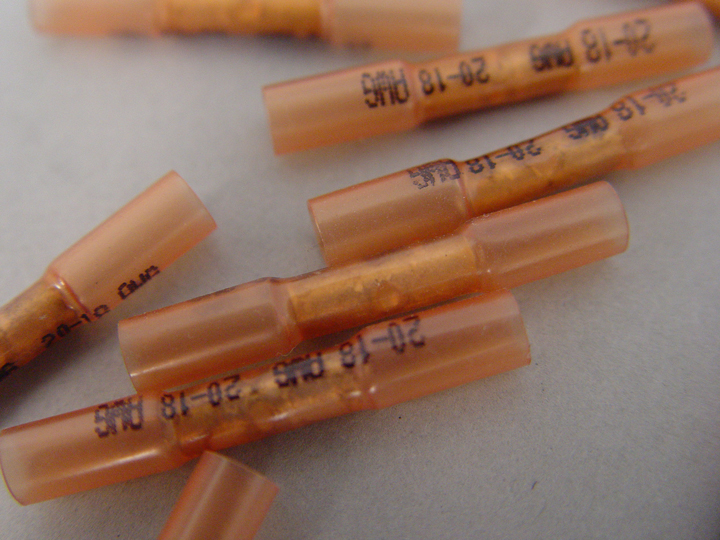 Figure 1 - These crimp and seal splice sleeves have special heat shrink sleeves on each end that shrink around the wire and form an air-tight seal.Confusion exists within the collision industry concerning the repair of some damaged wiring and wiring connectors for restraints systems. The perception is that restraints system wiring should never be repaired. While it is true that some vehicle makers do not recommend the repair of wiring and connectors for the restraints system, others have very detailed printed procedures and even offer repair kits expressly for the repair of restraints system wiring. Repairing damaged restraints system wiring, when applicable and the parts and procedures are available, can save unnecessary replacement of the main body and instrument panel wiring harnesses.
When it comes to repair information, vehicle makers use a wide variety of terminology for replacement parts. All of the different names can be confusing, especially when repairing a variety of vehicle makes and models. Thankfully, General Motors (GM) uses terms that most of us are familiar with.
This article originally appeared in the November/December edition of Fixed Ops Magazine.
Collision repair professionals are no different than any other professional – we are resistant to change. It took many years for repairers to make the switch to “MIG welding” for welding early unibody vehicles. (For this article we’ll use the term gas metal arc welding (GMAW) metal inert gas (MIG), or GMA (MIG)). (More on the reason, later.) It was a technology that was unfamiliar to many and there wasn’t a perceived need for change. History would prove otherwise, as there may not be a collision repair business in the country that doesn’t have a GMA (MIG) welder.
Repair or Replace? – Material Tensile Strength Key to Repairability
Jason Bartanen, I-CAR Director, Industry Technical Relations
The world of steels continues to evolve at a rapid pace and repair professionals need to keep up. In order to perform complete, safe, and quality repairs, it’s imperative to identify the type of material we’re working with, to know what is repairable, and know which options we have for part replacement when straightening is not an option.
by Chuck Olsen, Collision Diagnostic Services (CDS)
Strategy Based Diagnostics is an automotive best practice routine that was initially published by GM after studying and observing successful technicians in the field who consistently meet or exceed productivity standards with the lowest levels of "re-checks" or "comebacks." Since GM published this best practice, Strategy Based Diagnostics has been adopted by most in the automotive repair field.
Let's continue our breakdown of the columns in the OEM Technical Information Matrix. The eighth column calls out if the vehicle maker requires the use of weld-through primer on flanges in preparation for welding.
Let's continue our breakdown of the columns in the OEM Technical Information Matrix. The seventh column calls out if the vehicle maker has information in regard to the recommended attachment method and the equipment required for complete, quality, and safe repairs.
by Jason Bartanen
Ever since the unveiling of the 2015 Ford F-150 at the North American International Auto Show in Detroit in January, the U.S. automotive industry has been buzzing about this game changing, aluminum intensive vehicle.
The fourth column in the OEM Technical Information Matrix: Partial Service Part/Assembly Replacement Procedures at Factory Seams, can get a little tricky without further clarification. For the most part, this is a column that I-CAR is still researching published OEM information to get the answers to. The question is: Does the vehicle maker have procedures for replacing a partial service part or assembly at factory seams?
Did you know that in 2013, General Motors published a position statement that identifies that sectioning should only be performed in recommended areas? This warning is applicable to all GM lines including Buick, Cadillac, Chevrolet, and GMC.
Another version of electric-assist vehicle technology is showing up in collision repair facilities. General Motors in 2012 introduced what it refers to as "light electrification" technology on select models. This system is called eAssist, and is available on some 2012 Buick LaCrosse, Regal, and 2013 Chevrolet Malibu models (see Figure 1).
Until recently, General Motors has generally specified butt joints with backings when sectioning parts of a uniside. However, an overlap joint is now being required for some uniside sectioning joints. This is being done to reduce the transfer of heat from GMA welding into heat-sensitive high- and ultra-high-strength steel reinforcements. The concern with a butt joint with backing is that the backing piece does not extend to the pinchweld flange, and leaves the reinforcement exposed. As a result, a GMA weld is made on the pinchweld flange area of the reinforcement (see Figure 1).
I-CAR has been emphasizing the importance of three-dimensional measuring since its founding in 1979, but is it really required to repair a vehicle? After all, three-dimensional measuring systems are considerably more expensive compared to the much more affordable tape measure or tram gauge (see Figure 1).