Close
|
|


|
|
The summer edition of General Motors (GM) Repair Insights is now available.
While researching OEM repair information, you may come across specific notes, instructions, or warnings for high-voltage (HV) vehicles. Some general procedures can be easily overlooked, so it’s important to identify these circumstances. Let’s see what unique considerations General Motors (GM) has on EVs during a low-voltage disconnect.
We are often asked, “What do I do if there isn’t a procedure to replace a service part?” Let’s see what GM says.
Have you had the experience where the vehicle notified the owner that it was being moved while it was in your repair facility? App-based connected services are available from many vehicle makers and may require special considerations before beginning repairs. Let's see what General Motors (GM) has to say.
The intermingling of technology and automobiles continues, with digital key offerings from most vehicle makers. Digital keys utilize smartphone technology to expand vehicle access and owner convenience. Let’s see what General Motors (GM) has to offer.
Weld-through primers are generally a zinc-based product that are applied to the mating surfaces prior to welding. Corroding zinc forms zinc oxide which protects the steel. This is called sacrificial corrosion. For a quality weld to be made it’s required that the weld-through primer be removed from the direct weld zone before welding the joint when GMA welding. Many OEMs have a position on when and how to use weld-through primer or when it shouldn’t be utilized. Let’s see what General Motors (GM) recommends and where this information can be found.
The spring edition of General Motors (GM) Repair Insights magazine is now available.
High-voltage (HV) vehicles have some special considerations for handling and storing HV batteries and other components. The dangers of HV batteries are potential even after removal which is why certain precautions are needed. Let’s see what General Motors (GM) has to say.
The winter edition of General Motors (GM) Repair Insights magazine is now available.
The fall edition of General Motors (GM) Repair Insights magazine is now available.
I-CAR had a discussion on the top 5 I-CAR RTS linking pins of 2024.
Do you know which vehicle makers have collision repair information available? Do you know where you can go to find that out?
The summer edition of General Motors (GM) Repair Insights magazine is now available.
I-CAR had a discussion on vehicle highlights from the 2024 Chicago Auto Show.
The spring edition of General Motors (GM) Repair Insights magazine is now available.
The summer edition of General Motors (GM) Repair Insights magazine has recently been made available.
The fall edition of General Motors (GM) Repair Insights magazine has recently been made available.
The winter edition of General Motors (GM) Repair Insights magazine is now available.
Repairer Driven News (RDN) has released an article highlighting free online battery electric vehicle (BEV) first responder training from General Motors (GM).
As part of the I-CAR Repairability Technical Support (RTS) OEM linking pin activity, we are helping to connect the collision repair industry to the vehicle makers. We‘ve had technical inquiries that asked for clarification on repairing parts or assemblies with adhesively bonded joints on GM vehicles.
As electric-only, hybrid, and fuel cell electric vehicles are increasing in sales, they are becoming more commonplace in repair facilities. Along with the unique powertrains that come with these vehicles, also comes unique safety concerns. Regardless of vehicle maker, high-voltage (HV) systems pose a threat of injury or death if not handled properly. Only personnel with the proper training, PPE, tools, equipment, and service information should perform work on the HV systems.
Sometimes seeing is understanding, that’s why I-CAR's technical team created the Just in Time video series to guide you through a variety of collision repair topics from ADAS and EVs to repair tips and tricks. These videos enable you to, in less than 5 minutes, learn something new. Let’s check out the tip the team has for General Motors (GM) exhaust shield fasteners.
Sometimes, going back to the basics can make the difference between a quality repair and a failed repair. Tools for the door handle might not sound exciting, but they can save you frustration and possibly a refinish.
As a collision repair technician, there is one part of a service manual that houses all of the information you would ever need…right? This is not the case with modern vehicles. You may be required to look in numerous manuals to find the information required to safely repair the vehicle.
As part of the I-CAR Repairability Technical Support (RTS) OEM linking pin activity, we are helping to connect the collision repair industry to the vehicle makers. Recently, we had a technical inquiry that asked about inner quarter panel sectioning on a 2015 Cadillac ATS coupe.
When confronted with a wiring harness repair, we often struggle finding the correct connector and pigtail repair kits. Often a specific connector may be used on multiple applications. If the connector is allowed to be replaced, what resources are available to locate approved wiring connector and pigtail repair kits? Let’s see what is available from General Motors (GM).
Vehicle makers may group their body repair manuals (BRM) in several different ways. Sometimes the BRMs are grouped by a year range, some are listed as VIN specific, and others are arranged by a body code. Let’s take a look at General Motors (GM) to see how they group their BRMs.
The spring edition of General Motors (GM) Repair Insights magazine is now available.
The summer edition of the General Motors (GM) Repair Insights magazine is now available.
The winter edition of the General Motors (GM) Repair Insights magazine is now available.
A spring edition of the General Motors (GM) Repair Insights magazine is now available.
What is a one-time-use part, and how do you determine if a fastener, clip, or part can be reused? These are questions that we are confronted with in the collision industry quite a lot. The other big question is "Where do I find this information?"
As the Repairability Technical Support (RTS) team researches OEMs for one-time-use fastener/part information, we are putting together a series of articles on how and where to locate this information for specific OEMs. Let's take a look at General Motors (GM).
When researching procedures for disabling a high-voltage (HV) vehicle, you may notice that many of the procedures require the use of specific tools. Some of them are OEM-specific tools or scan tools. Often identifying and locating where to purchase these specific tools can be difficult.
The RTS team is researching how to find these tools to make it easier for technicians performing these tasks. As we research the location of these special tools, we are compiling the information in a series of OEM-specific articles.
A winter edition of the General Motors (GM) Repair Insights magazine is now available.
A fall edition of the General Motors (GM) Repair Insights magazine is now available.
General Motors (GM) has a document that covers advanced driver assistance systems (ADAS) information. The document provides an overview of all ADAS and components in one convenient location.
Repairer Driven News (RDN) released an article highlighting an upcoming advanced driver assistance systems (ADAS) change for General Motors (GM).
A summer edition of the General Motors (GM) Repair Insights magazine is now available. The issue highlights the 2022 Chevrolet Bolt EUV.
When performing collision repairs, there are more attachment methods available than ever before. OEMs specify which attachment methods are recommended or required. If a method is not listed as an option, it should not be used.
Are you looking for OEM emergency response guides (ERGs)? The Repairability Technical Support (RTS) team has located these guides and either houses them on the RTS website, provides links to webpages that house them, or provides articles with instructions on how to locate them.
Repairer Driven News (RDN) released an article on General Motors (GM) post-crash inspections and repair requirements document.
When researching calibration procedures for advanced driver assistance systems (ADAS), you may notice that many of the procedures require the use of specific tools. Some tools may be everyday items like string, tape, levels, paper, etc. However, many of them are OEM-specific tools or scan tools. Often identifying and locating where to purchase these specific tools can be difficult.
A spring edition of the General Motors (GM) Repair Insights magazine is now available. This issue highlights the all-new 2021 Buick Envision’s technology, performance, and safety.
Are you looking for OEM emergency response guides (ERGs)? The Repairability Technical Support (RTS) team has located these guides and either houses them on the RTS website, provides links to webpages that house them, or provides articles with instructions on how to locate them.
Did you know that some OEMs specify nugget size for spot and plug welds? This information is typically found within vehicle-specific repair procedures or can be found under general welding guidelines. Let’s see what General Motors (GM) has to say.
A winter edition of the General Motors (GM) Repair Insights magazine is now available.
In Europe, MIG brazing has been required or recommended on a widespread basis for several years. In the U.S., MIG brazing is not as common but is becoming more prevalent. As the RTS team is researching MIG brazing information, we are putting together a series of articles that identify OEM-specific MIG brazing recommendations and requirements for vehicles in the U.S. Let’s see what General Motors (GM) has to say.
In Europe, MIG brazing has been required or recommended on a widespread basis for several years. In the U.S., MIG brazing is not as common but is becoming more prevalent. As the RTS team is researching MIG brazing information, we are putting together a series of articles that identify OEM-specific MIG brazing recommendations and requirements for vehicles in the U.S.
The GM full-frame SUVs have undergone a redesign for 2021. This has brought about various structural changes, as well as construction material changes.
A fall edition of the General Motors (GM) Repair Insights magazine is now available.
Since hybrid and electric vehicles first started becoming relevant, members of the collision repair industry have required as much knowledge as possible on these subjects. I-CAR’s Repairability Technical Support (RTS) team continues to be on the leading edge of research and education. Our goal is to help communicate information to the industry, and a great way to do this is through Collision Repair News articles.
A summer edition of the General Motors (GM) Repair Insights magazine is now available.
Park assist sensors are part of the park assist system, just one of many advanced driver assistance systems (ADAS) found on vehicles today. Damaged sensors are typically replaced and may require painting to match the vehicle. Vehicle makers often provide information on the painting of new sensors. Some vehicle makers do not recommend refinishing sensors with minor finish damage because excessive paint thickness may adversely affect the operation of the park assist system. However, other vehicle makers allow refinishing and provide guidelines. Let’s see what General Motors (GM) has to say.
As advanced driver assistance systems (ADAS) are now commonplace and becoming available on even entry level models. Having information on ADAS, and when calibration is required for these systems is more important than ever.
Looking for more information about a specific repair procedure? Some OEMs are now providing videos within the repair procedures on their service site. Vehicle makers may also have additional websites that contain repair videos. As we research OEM websites and find these helpful videos, we will write articles to let you know. Let’s take a closer look at General Motors (GM).
A question often asked of the Repairability Technical Supports (RTS) team is, "Can heat be used to straighten?" Several OEMs provide steel repairability matrices that provide heating times and temperature limits based on the type of metal being repaired, while other OEMs have restrictions on using heat at all. Let’s see what General Motors (GM) has to say.
A spring edition of the General Motors (GM) Repair Insights magazine is now available.
Navigating OEM websites can be challenging when searching for collision repair procedures, especially as no two OEM websites are alike. What happens when you need to find other types of repair information, such as, "What needs to be inspected after a supplemental restraints system (SRS) deployment?", or "Does the tire pressure monitoring system (TPMS) require a scan tool or specialty tool?" Let's take a closer look at the General Motors (GM) website.
While searching for information on advanced driver assistance systems (ADAS) on an OEM repair information site, you may come across unique calibration procedures or events. These events can vary by year and model, even within a particular make. As the RTS team has been researching these systems, we have been identifying these atypical circumstances. In order to help you better understand them, we are putting together a series of articles that help with the repair and calibration of ADAS. Let’s take a look at GM manuals that cover multiple vehicles.
While many have noticed that advanced driver assistance systems (ADAS) are showing up on vehicles, there still is confusion on what is required of these systems after a collision occurs. The Ask I-CAR team frequently gets questions in regard to calibration of ADAS. Many of these questions can be answered simply by using the OEM Calibration Requirements Search. However, there are some questions that may need more details than the calibration search provides. Let’s take a look at the 2019 Cadillac XT5.
The GM Repair Insights website is back up after being down for a number of months. The Repairer News section of the site has solutions to specific issues for GM vehicles, such as wind noise on full-size trucks. With the re-publishing of this website, comes two new issues of the Insights magazine.
Repairer Driven News (RDN) released an article on Cadillac’s upgraded version of their hands-free driving system, Super Cruise. This improved system will allow the vehicle to change lanes with no driver input, other than engaging the turn signal.
One of the top technical inquiries received at Ask I-CAR is “Is there a sectioning or partial replacement procedure available?” To help answer this question, RTS has an OEM Partial Part Replacement Search available. Here you will find information on if these procedures are available on a specific vehicle. Let’s take a closer look at the 2020 Cadillac CT5.
The 2020 model year vehicles are starting to roll off the assembly line and into showrooms. The I-CAR course, Vehicle Technology And Trends 2020, covers the technology, model releases, and trends. Keeping up-to-date on the 2020 models and features is vital to the blueprinting and repair process.
Many General Motors repair procedures call for an overlap joint when replacing certain panels. There is now a separate “Overlap/Backing Plate Sectioning” procedure in some of the body repair manuals (BRM) on how to carry out the overlap joint.
One of the top technical inquiries received at Ask I-CAR is, “Is there a sectioning or partial replacement procedure available?” To help answer this question, RTS has an OEM Partial Part Replacement Search available. Here you will find information on if these procedures are available on a specific vehicle. Let’s take a closer look at the 2019 Cadillac XT4.
As you may know, General Motors has removed the body repair manuals from their free website www.gmparts.com.
Cadillac is releasing a new sedan with a substantial amount of advanced driver assistance systems (ADAS). The CT5 is equipped with many of the systems that you would expect to see in a luxury car, along with some new improvements not yet seen before in the market.
A simple bumper repair on a modern vehicle may not be as simple as it seems. New technologies like blind spot monitoring, adaptive cruise control, and other advanced driver assistance systems (ADAS) utilize sensors behind the bumper covers. The ability for these sensors to be able to see clearly normally requires special caution when considering a bumper repair. Many OEMs have different levels of warnings when it comes to repairing bumper covers with ADAS. So, what does General Motors (GM) say on the subject?
There is sometimes confusion on how many spot welds to use when replacing body components. Sometimes you replace what you removed, sometimes you use more or less than what was removed. It all depends on the particular vehicle you are repairing and what the manufacturer requires to be done. Luckily General Motors (GM) has a good way of identifying how many welds to use to install the new part.
Backup batteries sometimes referred to as auxiliary or supplemental batteries, serve an important role in maintaining power for certain vehicle systems even while the 12-volt battery power is cut. The backup batteries can aid in emergency situations by maintaining power for features like GM OnStar, Toyota Safety Connect System, and FCA Assist to name a few.
Suspension systems are made to absorb most of the impact of a bump in the road. This ultimately increases the ride quality from inside the vehicle. Over time, suspension has greatly improved. There are several different types of suspension, including active suspension.
General Motors (GM) has updated their www.acdelcotds.com service and repair information website. This update to the website changes how to find the collision repair information you need.
We’ve shared that OEMs like FCA, Honda/Acura, and Kia have videos within their procedures. Now, General Motors (GM) has added videos to various procedures in service manuals at www.acdelcotds.com.
One of the top technical inquiries received at Ask I-CAR is, “Is there a sectioning or partial replacement procedure available?” To help answer this question, RTS has an OEM Partial Part Replacement Search available. Here you will find information on if these procedures are available on a specific vehicle. Let’s take a closer look at the 2018 Cadillac CT6 Plug-In.
Since advanced driver assistance systems (ADAS), scanning, and calibration first started becoming relevant, members of the collision repair industry have required as much knowledge as possible on these subjects. I-CAR’s Repairability Technical Support (RTS) team continues to be on the leading edge of research and education. Our goal is to help communicate information to the industry, and a great way to do this is through Collision Repair News articles.
What is a non-SRS wiring repair? It is the repairing of an electrical component that is not part of the supplemental restraints system circuit (usually identified by yellow wire looms). As technology increases on vehicles, so does the number of components that utilize electricity. Many of the sensors and modules are becoming smarter and more sensitive. If the wire is too long, the wrong gauge, or spliced in the wrong location it can cause malfunctions in the components that it’s powering. Many OEMs have different restrictions and guidelines for repairing wiring that does not control SRS components. On the other hand, there are OEMs that don’t allow wiring repairs at all, so full harness replacement is the only option.
According to gmrepairinsights.com, there are rules that must be followed when using impact resistant (I.R.) structural adhesives. Per Bob Hiser, GM Lead Service Engineer, “The glue doesn’t tell you what it is or how to fix it.” This means that being trained and following the OEM repair instructions are crucial to a proper repair.
General Motors (GM) has launched their new Collision Repair Network and it is now open for enrollment. There are a number of qualifications an interested shop will be required to meet, including I-CAR training.
One of the top technical inquiries received at Ask I-CAR, "Is there a sectioning or partial replacement procedure available?" To help answer this question, RTS has an OEM Partial Part Replacement Search available. Here you will find information on if these procedures are available on a specific vehicle. Let's take a closer look at the 2017 Cadillac Escalade.
General Motors (GM) has updated their Metal Panel Bonding technical document on their gmparts website. Let’s take a look at this document.
ABRN published an article titled, Tackling the Repair of Mixed-Material Vehicles. Let’s take a look at this article.
A key part of being able to diagnose a problem with advanced driver assistance systems (ADAS) is understanding how the system works. Knowing what is happening inside the system will help you properly diagnose why the system may be failing. This will prevent replacing parts that are not causing the system issue. Let’s take a look at the inner workings of a collision warning and collision braking system.
A key part of being able to diagnose a problem with advanced driver assistance systems (ADAS) is understanding how the system works. Knowing what is happening inside the system will help you properly diagnose why the system may be failing. This will prevent replacing parts that are not causing the system issue. Let’s take a look at the inner workings of an adaptive cruise control system (ACC).
What’s on the repair agenda for 2018 GM vehicles? The expanded use of squeeze-type resistance spot welding (STRSW) over plug welds in the collision repair process. Repairer Driven News (RDN) published an article highlighting this upcoming change.
What is the MPa of the front lower rail? What is the outer uniside made of: steel, aluminum, or composite? Can heat be used to straighten or is it cold straightening only? What are the repair limitations? These are just some of the questions that the RTS team fields on a daily basis.
A key factor in collision repair is making long-lasting repairs. When a vehicle is repaired, many areas of corrosion protection are disturbed. This creates corrosion hot spots that left untreated will lead to corrosion and potentially a repair failure. However, there are certain precautions that can be taken to safely and properly restore the corrosion protection throughout the repair process. OEMs often give specifications on restoring corrosion protection. These specifications generally include seam sealer, adhesives, foam fillers, and cavity waxes. Let’s take a look at what General Motors (GM) says.
There is new information available when it comes to windshield replacement on General Motors (GM) vehicles. In the past, forward facing camera calibration was not required when replacing the windshield. Let’s take a look at the new requirement from GM.
The addition of the OEM Calibration Requirements Search to the RTS portal was a big step for the collision industry. While this new feature has been well received, there has been some confusion about what is included in the search tool. The OEM Calibration Requirements Search is designed to provide information on the calibration requirements that are needed for vehicles equipped with advanced driver assistance systems (ADAS). This includes systems such as adaptive cruise control, lane keep assist, and collision braking.
Collision Hub is a well-known source for collision repair news and information. On the Collision Hub website, you can find a monthly news report (Collision Hub Network News - CHNN), a blog, Repair University, and a relatively new feature Repair University Live. To view Repair University Live, you will need to purchase a subscription. However, the next episode, coming up on April 12, at 12:00 PM Eastern, will be sponsored by BASF, so it will be free to the public. Let’s take a look at how to view this episode and what it will include.
Ask I-CAR receives many technical inquiries referring to sectioning. The collision repair industry wants to know where can you section, does the OEM have a sectioning procedure, and where can I find the sectioning procedure? Most OEMs allow sectioning to outer body panels and the front and rear rails. Sectioning reinforcements is not as common, as most reinforcements are replaced at factory seams.
The role of the windshield is a lot more complex than simply allowing a view of the road ahead. It is considered a structural part of the vehicle as it contributes to the strength of the roof and A-pillars. The windshield helps to manage collision energy and has become an integral part of several advanced safety systems.
As the industry continues to ask, are pre- and post-repair scans necessary, General Motors provides their answer.
Why do I need a subscription to an OEM website if I have full subscription access to the I-CAR Repairability Technical Support (RTS) portal? This is a question received on a regular basis through Ask I-CAR. Let’s take a look at why and how to purchase an OEM subscription.
General Motors has followed suit with other OEMs by updating their position statement to disallow the use of recycled and salvage parts.
We often receive Ask I-CAR inquiries asking: “what does I-CAR recommend?” Many times these questions are in regards to sectioning, straightening, or part replacement/attachment methods. Our first response is always:
As OEMs continue to evolve the joining technologies used for new steel, aluminum, carbon fiber, and mixed material vehicles, I-CAR often gets questions of “what does this mean for the collision repair industry?”
Over the past few months, we've been sharing OEM position statements on restraints wiring repairs. Now we're bringing them all together in one place for easy reference.
The question is often asked, "Can supplemental restraints system wiring be repaired?" The answer is: it depends on the vehicle maker. Let's take a look at General Motors' (GM) position on this subject.
With the March release of the 2016 Cadillac CT6, there is no better time to become part of the Cadillac repair network. So what is involved in becoming part of the repair network? Let's take a look.
Article originally appeared in Repairer Driven News on November 5, 2015 By John Huetter
The days of fixing a car based on your own skill and experience alone are over. You’ve got to reference and follow the OEM procedures every time.
This was stressed over and over by experts in such diverse fields as scanning, joining, steel and aluminum Thursday at the Society of Collision Repair Specialists OEM Collision Repair Technology Summit at SEMA.
A group of vehicle makers got together recently and discussed the future of automatic emergency braking (AEB) technology in their vehicles. This feature is designed to reduce the severity and frequency of collisions; but no matter how good it is, it will never prevent all accidents from happening. So what do you need to know in order to repair vehicles with AEB, and how do you know the system is functioning properly?
The question is often asked, what material will be used in the car of the future? Should we concentrate on learning how to repair steel, aluminum, magnesium, or carbon fiber? For that answer, we need to look at present-day vehicles for some clues.
As a follow-up to the previous article on Paint Friendly Service Parts Coming From GM, General Motors has already begun supplying the part kits for some of their paint-to-match assemblies. The parts initially include door mirrors, headlamps, and door handles for some vehicles in 2015. For the 2016 model year, they will become available for most models, and for more than just these parts.
The I-CAR developed OEM Hybrid And Electric Vehicle Disable Search has been updated to include all General Motors makes including Buick, Cadilla, Chevrolet, and GMC hybrid vehicles through the 2024 model year.
A 2015 Cadillac ATS comes in that requires strut tower replacement. This is typically a straight forward repair, but on this vehicle the strut tower is cast aluminum. So now what?
Per your requests, we are adding step-by-step instructions on how to access the vehicle maker repair information to complement our how-to-videos on the OEM Information pages. Easily reference this article by clicking the link under the video on the Chevrolet OEM Information, Buick OEM Informationpage, GMC OEM Informationpage, and Cadillac OEM Information page.
Let's go back to basics with the ever-popular what to do with bumper energy absorbers, crush boxes, and bumper reinforcements.
The Recommended GM Steel Repairability Matrix is a chart that identifies GM’s repair recommendations according to the type of steel that the part is made from. The matrix contains information on the steel identification stamping symbols, steel grade, GM specifications, recommended welding methods, cold repairability, use of heat for repairs, the temperature range that should be used, and the maximum heat allotment. The second page of the matrix is a chart of Descriptions of GM Steel.
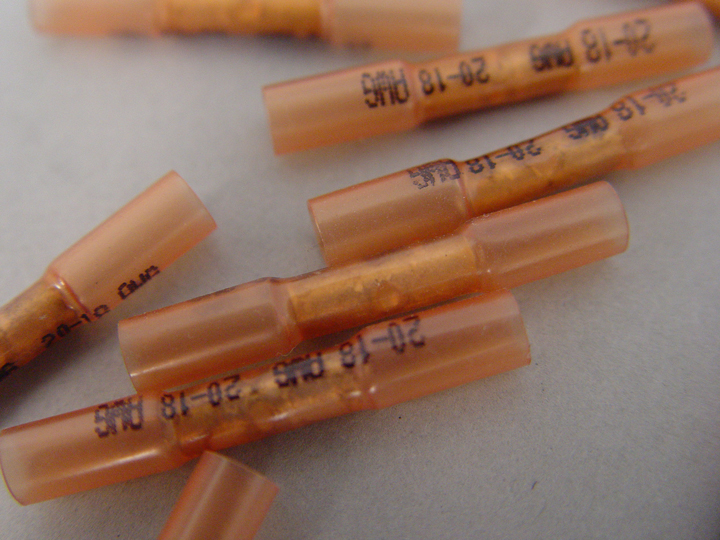 Figure 1 - These crimp and seal splice sleeves have special heat shrink sleeves on each end that shrink around the wire and form an air-tight seal.Confusion exists within the collision industry concerning the repair of some damaged wiring and wiring connectors for restraints systems. The perception is that restraints system wiring should never be repaired. While it is true that some vehicle makers do not recommend the repair of wiring and connectors for the restraints system, others have very detailed printed procedures and even offer repair kits expressly for the repair of restraints system wiring. Repairing damaged restraints system wiring, when applicable and the parts and procedures are available, can save unnecessary replacement of the main body and instrument panel wiring harnesses.
When it comes to repair information, vehicle makers use a wide variety of terminology for replacement parts. All of the different names can be confusing, especially when repairing a variety of vehicle makes and models. Thankfully, General Motors (GM) uses terms that most of us are familiar with.
This article originally appeared in the November/December edition of Fixed Ops Magazine.
Collision repair professionals are no different than any other professional – we are resistant to change. It took many years for repairers to make the switch to “MIG welding” for welding early unibody vehicles. (For this article we’ll use the term gas metal arc welding (GMAW) metal inert gas (MIG), or GMA (MIG)). (More on the reason, later.) It was a technology that was unfamiliar to many and there wasn’t a perceived need for change. History would prove otherwise, as there may not be a collision repair business in the country that doesn’t have a GMA (MIG) welder.
Repair or Replace? – Material Tensile Strength Key to Repairability
Jason Bartanen, I-CAR Director, Industry Technical Relations
The world of steels continues to evolve at a rapid pace and repair professionals need to keep up. In order to perform complete, safe, and quality repairs, it’s imperative to identify the type of material we’re working with, to know what is repairable, and know which options we have for part replacement when straightening is not an option.
by Chuck Olsen, Collision Diagnostic Services (CDS)
Strategy Based Diagnostics is an automotive best practice routine that was initially published by GM after studying and observing successful technicians in the field who consistently meet or exceed productivity standards with the lowest levels of "re-checks" or "comebacks." Since GM published this best practice, Strategy Based Diagnostics has been adopted by most in the automotive repair field.
Let's continue our breakdown of the columns in the OEM Technical Information Matrix. The eighth column calls out if the vehicle maker requires the use of weld-through primer on flanges in preparation for welding.
Let's continue our breakdown of the columns in the OEM Technical Information Matrix. The seventh column calls out if the vehicle maker has information in regard to the recommended attachment method and the equipment required for complete, quality, and safe repairs.
by Jason Bartanen
Ever since the unveiling of the 2015 Ford F-150 at the North American International Auto Show in Detroit in January, the U.S. automotive industry has been buzzing about this game changing, aluminum intensive vehicle.
The fourth column in the OEM Technical Information Matrix: Partial Service Part/Assembly Replacement Procedures at Factory Seams, can get a little tricky without further clarification. For the most part, this is a column that I-CAR is still researching published OEM information to get the answers to. The question is: Does the vehicle maker have procedures for replacing a partial service part or assembly at factory seams?
Did you know that in 2013, General Motors published a position statement that identifies that sectioning should only be performed in recommended areas? This warning is applicable to all GM lines including Buick, Cadillac, Chevrolet, and GMC.
Another version of electric-assist vehicle technology is showing up in collision repair facilities. General Motors in 2012 introduced what it refers to as "light electrification" technology on select models. This system is called eAssist, and is available on some 2012 Buick LaCrosse, Regal, and 2013 Chevrolet Malibu models (see Figure 1).
Until recently, General Motors has generally specified butt joints with backings when sectioning parts of a uniside. However, an overlap joint is now being required for some uniside sectioning joints. This is being done to reduce the transfer of heat from GMA welding into heat-sensitive high- and ultra-high-strength steel reinforcements. The concern with a butt joint with backing is that the backing piece does not extend to the pinchweld flange, and leaves the reinforcement exposed. As a result, a GMA weld is made on the pinchweld flange area of the reinforcement (see Figure 1).
I-CAR has been emphasizing the importance of three-dimensional measuring since its founding in 1979, but is it really required to repair a vehicle? After all, three-dimensional measuring systems are considerably more expensive compared to the much more affordable tape measure or tram gauge (see Figure 1).
The summer edition of General Motors (GM) Repair Insights is now available.
While researching OEM repair information, you may come across specific notes, instructions, or warnings for high-voltage (HV) vehicles. Some general procedures can be easily overlooked, so it’s important to identify these circumstances. Let’s see what unique considerations General Motors (GM) has on EVs during a low-voltage disconnect.
We are often asked, “What do I do if there isn’t a procedure to replace a service part?” Let’s see what GM says.
In case you missed it, Senior Body Engineer, Jinhui Wang presented Body Structure Efficiency On D-Segment Crossover Architecture at Great Designs in Steel 2025.
Have you had the experience where the vehicle notified the owner that it was being moved while it was in your repair facility? App-based connected services are available from many vehicle makers and may require special considerations before beginning repairs. Let's see what General Motors (GM) has to say.
The intermingling of technology and automobiles continues, with digital key offerings from most vehicle makers. Digital keys utilize smartphone technology to expand vehicle access and owner convenience. Let’s see what General Motors (GM) has to offer.
Weld-through primers are generally a zinc-based product that are applied to the mating surfaces prior to welding. Corroding zinc forms zinc oxide which protects the steel. This is called sacrificial corrosion. For a quality weld to be made it’s required that the weld-through primer be removed from the direct weld zone before welding the joint when GMA welding. Many OEMs have a position on when and how to use weld-through primer or when it shouldn’t be utilized. Let’s see what General Motors (GM) recommends and where this information can be found.
The spring edition of General Motors (GM) Repair Insights magazine is now available.
High-voltage (HV) vehicles have some special considerations for handling and storing HV batteries and other components. The dangers of HV batteries are potential even after removal which is why certain precautions are needed. Let’s see what General Motors (GM) has to say.
The winter edition of General Motors (GM) Repair Insights magazine is now available.
The fall edition of General Motors (GM) Repair Insights magazine is now available.
I-CAR had a discussion on the top 5 I-CAR RTS linking pins of 2024.
Do you know which vehicle makers have collision repair information available? Do you know where you can go to find that out?
The summer edition of General Motors (GM) Repair Insights magazine is now available.
Great Designs in Steel (GDIS) 2024 covered multiple topics many of which are presented by OEM engineers and tier 1 suppliers of body components.
I-CAR had a discussion on vehicle highlights from the 2024 Chicago Auto Show.
The spring edition of General Motors (GM) Repair Insights magazine is now available.
The summer edition of General Motors (GM) Repair Insights magazine has recently been made available.
The fall edition of General Motors (GM) Repair Insights magazine has recently been made available.
The winter edition of General Motors (GM) Repair Insights magazine is now available.
Repairer Driven News (RDN) has released an article highlighting free online battery electric vehicle (BEV) first responder training from General Motors (GM).
As part of the I-CAR Repairability Technical Support (RTS) OEM linking pin activity, we are helping to connect the collision repair industry to the vehicle makers. We‘ve had technical inquiries that asked for clarification on repairing parts or assemblies with adhesively bonded joints on GM vehicles.
As electric-only, hybrid, and fuel cell electric vehicles are increasing in sales, they are becoming more commonplace in repair facilities. Along with the unique powertrains that come with these vehicles, also comes unique safety concerns. Regardless of vehicle maker, high-voltage (HV) systems pose a threat of injury or death if not handled properly. Only personnel with the proper training, PPE, tools, equipment, and service information should perform work on the HV systems.
Anchoring the vehicle for repair is as critical as other repair operations. When done incorrectly, it may lead to unforeseen damage.
Sometimes seeing is understanding, that’s why I-CAR's technical team created the Just in Time video series to guide you through a variety of collision repair topics from ADAS and EVs to repair tips and tricks. These videos enable you to, in less than 5 minutes, learn something new. Let’s check out the tip the team has for General Motors (GM) exhaust shield fasteners.
Sometimes, going back to the basics can make the difference between a quality repair and a failed repair. Tools for the door handle might not sound exciting, but they can save you frustration and possibly a refinish.
As a collision repair technician, there is one part of a service manual that houses all of the information you would ever need…right? This is not the case with modern vehicles. You may be required to look in numerous manuals to find the information required to safely repair the vehicle.
When confronted with a wiring harness repair, we often struggle finding the correct connector and pigtail repair kits. Often a specific connector may be used on multiple applications. If the connector is allowed to be replaced, what resources are available to locate approved wiring connector and pigtail repair kits? Let’s see what is available from General Motors (GM).
Vehicle makers may group their body repair manuals (BRM) in several different ways. Sometimes the BRMs are grouped by a year range, some are listed as VIN specific, and others are arranged by a body code. Let’s take a look at General Motors (GM) to see how they group their BRMs.
The spring edition of General Motors (GM) Repair Insights magazine is now available.
The summer edition of the General Motors (GM) Repair Insights magazine is now available.
The winter edition of the General Motors (GM) Repair Insights magazine is now available.
As part of the I-CAR Repairability Technical Support (RTS) OEM linking pin activity, we are helping to connect the collision repair industry to the vehicle makers. Recently, we had a technical inquiry that asked on the type of sectioning joint to be used in the quarter glass flange when sectioning the outer quarter panel on a 2020 Chevrolet Tahoe. The lap joint specified in the procedure would prevent the quarter glass from being seated properly. We reached out to GM for clarification.
A spring edition of the General Motors (GM) Repair Insights magazine is now available.
What is a one-time-use part, and how do you determine if a fastener, clip, or part can be reused? These are questions that we are confronted with in the collision industry quite a lot. The other big question is "Where do I find this information?"
As the Repairability Technical Support (RTS) team researches OEMs for one-time-use fastener/part information, we are putting together a series of articles on how and where to locate this information for specific OEMs. Let's take a look at General Motors (GM).
When researching procedures for disabling a high-voltage (HV) vehicle, you may notice that many of the procedures require the use of specific tools. Some of them are OEM-specific tools or scan tools. Often identifying and locating where to purchase these specific tools can be difficult.
The RTS team is researching how to find these tools to make it easier for technicians performing these tasks. As we research the location of these special tools, we are compiling the information in a series of OEM-specific articles.
A winter edition of the General Motors (GM) Repair Insights magazine is now available.
A fall edition of the General Motors (GM) Repair Insights magazine is now available.
General Motors (GM) has a document that covers advanced driver assistance systems (ADAS) information. The document provides an overview of all ADAS and components in one convenient location.
Repairer Driven News (RDN) released an article highlighting an upcoming advanced driver assistance systems (ADAS) change for General Motors (GM).
A summer edition of the General Motors (GM) Repair Insights magazine is now available. The issue highlights the 2022 Chevrolet Bolt EUV.
When performing collision repairs, there are more attachment methods available than ever before. OEMs specify which attachment methods are recommended or required. If a method is not listed as an option, it should not be used.
Are you looking for OEM emergency response guides (ERGs)? The Repairability Technical Support (RTS) team has located these guides and either houses them on the RTS website, provides links to webpages that house them, or provides articles with instructions on how to locate them.
Repairer Driven News (RDN) released an article on General Motors (GM) post-crash inspections and repair requirements document.
When researching calibration procedures for advanced driver assistance systems (ADAS), you may notice that many of the procedures require the use of specific tools. Some tools may be everyday items like string, tape, levels, paper, etc. However, many of them are OEM-specific tools or scan tools. Often identifying and locating where to purchase these specific tools can be difficult.
A spring edition of the General Motors (GM) Repair Insights magazine is now available. This issue highlights the all-new 2021 Buick Envision’s technology, performance, and safety.
Are you looking for OEM emergency response guides (ERGs)? The Repairability Technical Support (RTS) team has located these guides and either houses them on the RTS website, provides links to webpages that house them, or provides articles with instructions on how to locate them.
Did you know that some OEMs specify nugget size for spot and plug welds? This information is typically found within vehicle-specific repair procedures or can be found under general welding guidelines. Let’s see what General Motors (GM) has to say.
A winter edition of the General Motors (GM) Repair Insights magazine is now available.
In Europe, MIG brazing has been required or recommended on a widespread basis for several years. In the U.S., MIG brazing is not as common but is becoming more prevalent. As the RTS team is researching MIG brazing information, we are putting together a series of articles that identify OEM-specific MIG brazing recommendations and requirements for vehicles in the U.S. Let’s see what General Motors (GM) has to say.
In Europe, MIG brazing has been required or recommended on a widespread basis for several years. In the U.S., MIG brazing is not as common but is becoming more prevalent. As the RTS team is researching MIG brazing information, we are putting together a series of articles that identify OEM-specific MIG brazing recommendations and requirements for vehicles in the U.S.
The GM full-frame SUVs have undergone a redesign for 2021. This has brought about various structural changes, as well as construction material changes.
A fall edition of the General Motors (GM) Repair Insights magazine is now available.
Chevrolet introduced the latest generation Corvette, the C8. This 2020 model is completely redesigned and only uses one part from the previous generation. I-CAR developed a course in cooperation with the vehicle maker for the Chevrolet Corvette C8.
A summer edition of the General Motors (GM) Repair Insights magazine is now available.
Park assist sensors are part of the park assist system, just one of many advanced driver assistance systems (ADAS) found on vehicles today. Damaged sensors are typically replaced and may require painting to match the vehicle. Vehicle makers often provide information on the painting of new sensors. Some vehicle makers do not recommend refinishing sensors with minor finish damage because excessive paint thickness may adversely affect the operation of the park assist system. However, other vehicle makers allow refinishing and provide guidelines. Let’s see what General Motors (GM) has to say.
The 2019 Chevrolet Silverado and GMC Sierra have two procedures for replacing the front-end module (Body Front Structure Parts Replacement). The front-end module consists of the radiator core support, front upper rail assemblies, front wheelhouse panel reinforcement, and supporting brackets. These procedures are differentiated depending when the vehicle was built. While researching these procedures, we observed what appeared to be conflicting information within the procedures. We reached out to General Motors (GM). Here is what they had to say.
As advanced driver assistance systems (ADAS) are now commonplace and becoming available on even entry level models. Having information on ADAS, and when calibration is required for these systems is more important than ever.
Looking for more information about a specific repair procedure? Some OEMs are now providing videos within the repair procedures on their service site. Vehicle makers may also have additional websites that contain repair videos. As we research OEM websites and find these helpful videos, we will write articles to let you know. Let’s take a closer look at General Motors (GM).
A question often asked of the Repairability Technical Supports (RTS) team is, "Can heat be used to straighten?" Several OEMs provide steel repairability matrices that provide heating times and temperature limits based on the type of metal being repaired, while other OEMs have restrictions on using heat at all. Let’s see what General Motors (GM) has to say.
A spring edition of the General Motors (GM) Repair Insights magazine is now available.
Navigating OEM websites can be challenging when searching for collision repair procedures, especially as no two OEM websites are alike. What happens when you need to find other types of repair information, such as, "What needs to be inspected after a supplemental restraints system (SRS) deployment?", or "Does the tire pressure monitoring system (TPMS) require a scan tool or specialty tool?" Let's take a closer look at the General Motors (GM) website.
While searching for information on advanced driver assistance systems (ADAS) on an OEM repair information site, you may come across unique calibration procedures or events. These events can vary by year and model, even within a particular make. As the RTS team has been researching these systems, we have been identifying these atypical circumstances. In order to help you better understand them, we are putting together a series of articles that help with the repair and calibration of ADAS. Let’s take a look at GM manuals that cover multiple vehicles.
The GM Repair Insights website is back up after being down for a number of months. The Repairer News section of the site has solutions to specific issues for GM vehicles, such as wind noise on full-size trucks. With the re-publishing of this website, comes two new issues of the Insights magazine.
As part of the I-CAR Repairability Technical Support (RTS) OEM linking pin activity, we are helping to connect the collision repair industry to the vehicle makers. Recently we had a technical inquiry that asked for clarification on the radiator core support procedure on the 2019 Chevrolet Silverado/GMC Sierra new model light duty (LD).
Many General Motors repair procedures call for an overlap joint when replacing certain panels. There is now a separate “Overlap/Backing Plate Sectioning” procedure in some of the body repair manuals (BRM) on how to carry out the overlap joint.
While many have noticed that advanced driver assistance systems (ADAS) are showing up on vehicles, there still is confusion on what is required of these systems after a collision occurs. The Ask I-CAR team frequently gets questions in regard to calibration of ADAS. Many of these questions can be answered simply by searching the OEM Calibration Requirements Search. However, there are some questions that may need more detail than the calibration search provides. Let’s take a look at the 2019 Chevrolet Silverado ADAS.
There are many precautions and instructions to follow while repairing hybrid and electric vehicles. To help you find this information, RTS has an OEM Hybrid And Electric Vehicle Disable Search page. Here you will find step-by-step instructions on how to find the disable procedure in the service manual. You will also find precautions for welding, refinishing, and if a scan tool and DVOM are required for disabling. Let’s take a look at the 2019 Chevrolet Volt.
On the 2017 and newer Chevrolet Cruze, if you read through some of the procedures, like the Rear Wheelhouse Panel Replacement procedure, you may find yourself asking, “What is the waterproof rivet B1 referenced in the installation procedure?” Let’s find out.
The 2020 Chevrolet Silverado/GMC Sierra vehicles have been redesigned. To help technicians be aware of the design changes and what these changes mean to the collision repair industry, General Motors (GM) has worked with I-CAR to develop a course.
Repairer Driven News (RDN) released an article on the 2020 Corvette Stingray, which outlines the variety of materials used in the light-weight construction of the vehicle. The mid-engine vehicle has been called “a smart mixed-materials strategy” by Chevrolet.
The I-CAR Repairability Technical Support (RTS) team recently developed a new I-CAR 360 video on the 2019 Chevrolet Silverado/GMC Sierra light duty. The video provides a 360 tour around the new Silverado/Sierra, and the body in white.
As you may know, General Motors has removed the body repair manuals from their free website www.gmparts.com.
A simple bumper repair on a modern vehicle may not be as simple as it seems. New technologies like blind spot monitoring, adaptive cruise control, and other advanced driver assistance systems (ADAS) utilize sensors behind the bumper covers. The ability for these sensors to be able to see clearly normally requires special caution when considering a bumper repair. Many OEMs have different levels of warnings when it comes to repairing bumper covers with ADAS. So, what does General Motors (GM) say on the subject?
There is sometimes confusion on how many spot welds to use when replacing body components. Sometimes you replace what you removed, sometimes you use more or less than what was removed. It all depends on the particular vehicle you are repairing and what the manufacturer requires to be done. Luckily General Motors (GM) has a good way of identifying how many welds to use to install the new part.
Backup batteries sometimes referred to as auxiliary or supplemental batteries, serve an important role in maintaining power for certain vehicle systems even while the 12-volt battery power is cut. The backup batteries can aid in emergency situations by maintaining power for features like GM OnStar, Toyota Safety Connect System, and FCA Assist to name a few.
General Motors (GM) has updated their www.acdelcotds.com service and repair information website. This update to the website changes how to find the collision repair information you need.
One of the top technical inquiries received at Ask I-CAR is “Is there a sectioning or partial replacement procedure available?” To help answer this question, RTS has an OEM Partial Part Replacement Search available. Here you will find information on if these procedures are available on a specific vehicle. Let’s take a closer look at the 2019 Chevrolet Silverado.
We’ve shared that OEMs like FCA, Honda/Acura, and Kia have videos within their procedures. Now, General Motors (GM) has added videos to various procedures in service manuals at www.acdelcotds.com.
General Motors unveiled the redesigned versions of their heavy duty 2020 Chevrolet Silverado and GMC Sierra at the 2019 Chicago Auto Show. The new models will have two available powertrain options, a gas and a diesel. Many new standard and available features have been built into these trucks with work in mind.
Since advanced driver assistance systems (ADAS), scanning, and calibration first started becoming relevant, members of the collision repair industry have required as much knowledge as possible on these subjects. I-CAR’s Repairability Technical Support (RTS) team continues to be on the leading edge of research and education. Our goal is to help communicate information to the industry, and a great way to do this is through Collision Repair News articles.
The 2019 Chevrolet Silverado/GMC Sierra vehicles have been fully redesigned. To help you stay abreast of the design changes and what these changes mean to the collision repair industry, General Motors (GM) has worked with I-CAR to develop a course.
What is a non-SRS wiring repair? It is the repairing of an electrical component that is not part of the supplemental restraints system circuit (usually identified by yellow wire looms). As technology increases on vehicles, so does the number of components that utilize electricity. Many of the sensors and modules are becoming smarter and more sensitive. If the wire is too long, the wrong gauge, or spliced in the wrong location it can cause malfunctions in the components that it’s powering. Many OEMs have different restrictions and guidelines for repairing wiring that does not control SRS components. On the other hand, there are OEMs that don’t allow wiring repairs at all, so full harness replacement is the only option.
According to gmrepairinsights.com, there are rules that must be followed when using impact resistant (I.R.) structural adhesives. Per Bob Hiser, GM Lead Service Engineer, “The glue doesn’t tell you what it is or how to fix it.” This means that being trained and following the OEM repair instructions are crucial to a proper repair.
One of the top technical inquiries received at Ask I-CAR is “Is there a sectioning or partial replacement procedure available?” To help answer this question, RTS has an OEM Partial Part Replacement Search available. Here you will find information on if these procedures are available on a specific vehicle. Let’s take a closer look at the 2017 Chevrolet Malibu.
General Motors (GM) has launched their new Collision Repair Network and it is now open for enrollment. There are a number of qualifications an interested shop will be required to meet, including I-CAR training.
One of the top technical inquires received at Ask I-CAR, "Is there a sectioning or partial replacement procedure available?" To help answer this question, RTS has an OEM Partial Part Replacement Search available. Here you will find information on if these procedures are available on a specific vehicle. Let's take a closer look at the 2017 Chevrolet Silverado.
In case you missed it, Jeff Sulik, Engineering Group Manager and Joy Geeraerts, Senior Design Release Engineer from General Motors Company presented The All-New 2019 Chevrolet Silverado Structure Review at Great Designs in Steel 2018.
One of the top technical inquiries received at Ask I-CAR, "Is there a sectioning or partial replacement procedure available?" To help answer this question, RTS has an OEM Partial Part Replacement Search available. Here you will find information on if these procedures are available on a specific vehicle. Let's take a closer look at the 2017 Tahoe/Suburban.
One of the top technical inquiries received at Ask I-CAR, “Is there a sectioning or partial replacement procedure available?” To help answer this question, RTS has an OEM Partial Part Replacement Search available. Here you will find information on if these procedures are available on a specific vehicle. Let’s take a closer look at the 2017 Chevrolet Impala.
General Motors (GM) has updated their Metal Panel Bonding technical document on their gmparts website. Let’s take a look at this document.
ABRN published an article titled, Tackling the Repair of Mixed-Material Vehicles. Let’s take a look at this article.
What’s on the repair agenda for 2018 GM vehicles? The expanded use of squeeze-type resistance spot welding (STRSW) over plug welds in the collision repair process. Repairer Driven News (RDN) published an article highlighting this upcoming change.
What is the MPa of the front lower rail? What is the outer uniside made of: steel, aluminum, or composite? Can heat be used to straighten or is it cold straightening only? What are the repair limitations? These are just some of the questions that the RTS team fields on a daily basis.
A key factor in collision repair is making long-lasting repairs. When a vehicle is repaired, many areas of corrosion protection are disturbed. This creates corrosion hot spots that left untreated will lead to corrosion and potentially a repair failure. However, there are certain precautions that can be taken to safely and properly restore the corrosion protection throughout the repair process. OEMs often give specifications on restoring corrosion protection. These specifications generally include seam sealer, adhesives, foam fillers, and cavity waxes. Let’s take a look at what General Motors (GM) says.
There is new information available when it comes to windshield replacement on General Motors (GM) vehicles. In the past, forward facing camera calibration was not required when replacing the windshield. Let’s take a look at the new requirement from GM.
The addition of the OEM Calibration Requirements Search to the RTS portal was a big step for the collision industry. While this new feature has been well received, there has been some confusion about what is included in the search tool. The OEM Calibration Requirements Search is designed to provide information on the calibration requirements that are needed for vehicles equipped with advanced driver assistance systems (ADAS). This includes systems such as adaptive cruise control, lane keep assist, and collision braking.
Collision Hub is a well-known source for collision repair news and information. On the Collision Hub website, you can find a monthly news report (Collision Hub Network News - CHNN), a blog, Repair University, and a relatively new feature Repair University Live. To view Repair University Live, you will need to purchase a subscription. However, the next episode, coming up on April 12, at 12:00 PM Eastern, will be sponsored by BASF, so it will be free to the public. Let’s take a look at how to view this episode and what it will include.
Ask I-CAR receives many technical inquiries referring to sectioning. The collision repair industry wants to know where can you section, does the OEM have a sectioning procedure, and where can I find the sectioning procedure? Most OEMs allow sectioning to outer body panels and the front and rear rails. Sectioning reinforcements is not as common, as most reinforcements are replaced at factory seams.
The I-CAR Repairability Technical Support (RTS) team recently developed a new I-CAR 360 video on the 2017 Chevrolet Bolt EV. The video provides a 360 tour around the new Bolt EV.
Accessing the body repair manual before performing a repair has become increasingly critical. Ask I-CAR has received an inquiry, “I can’t find the sectioning procedure for the front lower rail on the 2016 Chevrolet Malibu? We’ve sectioned the front lower rail on Malibu’s in the past?” After researching the repair information, we found the answer. Let’s take a look at what was found.
The role of the windshield is a lot more complex than simply allowing a view of the road ahead. It is considered a structural part of the vehicle as it contributes to the strength of the roof and A-pillars. The windshield helps to manage collision energy and has become an integral part of several advanced safety systems.
As the industry continues to ask, are pre- and post-repair scans necessary, General Motors provides their answer.
Why do I need a subscription to an OEM website if I have full subscription access to the I-CAR Repairability Technical Support (RTS) portal? This is a question received on a regular basis through Ask I-CAR. Let’s take a look at why and how to purchase an OEM subscription.
General Motors has followed suit with other OEMs by updating their position statement to disallow the use of recycled and salvage parts.
We often receive Ask I-CAR inquiries asking: “what does I-CAR recommend?” Many times these questions are in regards to sectioning, straightening, or part replacement/attachment methods. Our first response is always:
As OEMs continue to evolve the joining technologies used for new steel, aluminum, carbon fiber, and mixed material vehicles, I-CAR often gets questions of “what does this mean for the collision repair industry?”
Over the past few months, we've been sharing OEM position statements on restraints wiring repairs. Now we're bringing them all together in one place for easy reference.
The question is often asked, "Can supplemental restraints system wiring be repaired?" The answer is: it depends on the vehicle maker. Let's take a look at General Motors' (GM) position on this subject.
A group of vehicle makers got together recently and discussed the future of automatic emergency braking (AEB) technology in their vehicles. This feature is designed to reduce the severity and frequency of collisions; but no matter how good it is, it will never prevent all accidents from happening. So what do you need to know in order to repair vehicles with AEB, and how do you know the system is functioning properly?
As a follow-up to the previous article on Paint Friendly Service Parts Coming From GM, General Motors has already begun supplying the part kits for some of their paint-to-match assemblies. The parts initially include door mirrors, headlamps, and door handles for some vehicles in 2015. For the 2016 model year, they will become available for most models, and for more than just these parts.
The I-CAR developed OEM Hybrid And Electric Vehicle Disable Search has been updated to include all General Motors makes including Buick, Cadilla, Chevrolet, and GMC hybrid vehicles through the 2024 model year.
Per your requests, we are adding step-by-step instructions on how to access the vehicle maker repair information to complement our how-to-videos on the OEM Information pages. Easily reference this article by clicking the link under the video on the Chevrolet OEM Information, Buick OEM Informationpage, GMC OEM Informationpage, and Cadillac OEM Information page.
Let's go back to basics with the ever-popular what to do with bumper energy absorbers, crush boxes, and bumper reinforcements.
The Recommended GM Steel Repairability Matrix is a chart that identifies GM’s repair recommendations according to the type of steel that the part is made from. The matrix contains information on the steel identification stamping symbols, steel grade, GM specifications, recommended welding methods, cold repairability, use of heat for repairs, the temperature range that should be used, and the maximum heat allotment. The second page of the matrix is a chart of Descriptions of GM Steel.
Figure 1 - These crimp and seal splice sleeves have special heat shrink sleeves on each end that shrink around the wire and form an air-tight seal.Confusion exists within the collision industry concerning the repair of some damaged wiring and wiring connectors for restraints systems. The perception is that restraints system wiring should never be repaired. While it is true that some vehicle makers do not recommend the repair of wiring and connectors for the restraints system, others have very detailed printed procedures and even offer repair kits expressly for the repair of restraints system wiring. Repairing damaged restraints system wiring, when applicable and the parts and procedures are available, can save unnecessary replacement of the main body and instrument panel wiring harnesses.
The 2010-2015 Chevrolet Camaro is built on a General Motors global rear-wheel drive platform and shares some of the same chassis parts with the Pontiac GTO and G8. Although the new Camaro looks like a 1969 Camaro, it is quite different from a collision repair point of view. This article covers some of the repair options and considerations when working on a collision-damaged Camaro. General Motors body repair procedures and mechanical/electronic systems can be accessed by visiting www.acdelcotds.com.
When it comes to repair information, vehicle makers use a wide variety of terminology for replacement parts. All of the different names can be confusing, especially when repairing a variety of vehicle makes and models. Thankfully, General Motors (GM) uses terms that most of us are familiar with.
This article originally appeared in the November/December edition of Fixed Ops Magazine.
Collision repair professionals are no different than any other professional – we are resistant to change. It took many years for repairers to make the switch to “MIG welding” for welding early unibody vehicles. (For this article we’ll use the term gas metal arc welding (GMAW) metal inert gas (MIG), or GMA (MIG)). (More on the reason, later.) It was a technology that was unfamiliar to many and there wasn’t a perceived need for change. History would prove otherwise, as there may not be a collision repair business in the country that doesn’t have a GMA (MIG) welder.
Repair or Replace? – Material Tensile Strength Key to Repairability
Jason Bartanen, I-CAR Director, Industry Technical Relations
The world of steels continues to evolve at a rapid pace and repair professionals need to keep up. In order to perform complete, safe, and quality repairs, it’s imperative to identify the type of material we’re working with, to know what is repairable, and know which options we have for part replacement when straightening is not an option.
by Chuck Olsen, Collision Diagnostic Services (CDS)
Strategy Based Diagnostics is an automotive best practice routine that was initially published by GM after studying and observing successful technicians in the field who consistently meet or exceed productivity standards with the lowest levels of "re-checks" or "comebacks." Since GM published this best practice, Strategy Based Diagnostics has been adopted by most in the automotive repair field.
Let's continue our breakdown of the columns in the OEM Technical Information Matrix. The eighth column calls out if the vehicle maker requires the use of weld-through primer on flanges in preparation for welding.
Let's continue our breakdown of the columns in the OEM Technical Information Matrix. The seventh column calls out if the vehicle maker has information in regard to the recommended attachment method and the equipment required for complete, quality, and safe repairs.
by Jason Bartanen
Ever since the unveiling of the 2015 Ford F-150 at the North American International Auto Show in Detroit in January, the U.S. automotive industry has been buzzing about this game changing, aluminum intensive vehicle.
General Motors released a new full-frame sectioning kit for the front frame rails on 2011 - current 2500/3500 GMC Sierra and 2500/3500 Chevrolet Silverado. A similar kit has been available for the light-duty pickups, but this new part kit is specific to the heavy-duty pickups.
The fourth column in the OEM Technical Information Matrix: Partial Service Part/Assembly Replacement Procedures at Factory Seams, can get a little tricky without further clarification. For the most part, this is a column that I-CAR is still researching published OEM information to get the answers to. The question is: Does the vehicle maker have procedures for replacing a partial service part or assembly at factory seams?
Did you know that in 2013, General Motors published a position statement that identifies that sectioning should only be performed in recommended areas? This warning is applicable to all GM lines including Buick, Cadillac, Chevrolet, and GMC.
by Jason Bartanen
We've seen a lot of changes in vehicle technology over the years. With each of these changes come new challenges and new opportunities. When the unibody vehicle was introduced, repair professionals were required to change their approach to collision repair, from damage analysis through the repair process. With the introduction of GMA (MIG) welding, additional requirements for repairs included new training and equipment. And passive restraints systems presented a completely different type of challenge, involving electronics and diagnostics.
Another version of electric-assist vehicle technology is showing up in collision repair facilities. General Motors in 2012 introduced what it refers to as "light electrification" technology on select models. This system is called eAssist, and is available on some 2012 Buick LaCrosse, Regal, and 2013 Chevrolet Malibu models (see Figure 1).
Until recently, General Motors has generally specified butt joints with backings when sectioning parts of a uniside. However, an overlap joint is now being required for some uniside sectioning joints. This is being done to reduce the transfer of heat from GMA welding into heat-sensitive high- and ultra-high-strength steel reinforcements. The concern with a butt joint with backing is that the backing piece does not extend to the pinchweld flange, and leaves the reinforcement exposed. As a result, a GMA weld is made on the pinchweld flange area of the reinforcement (see Figure 1).
I-CAR has been emphasizing the importance of three-dimensional measuring since its founding in 1979, but is it really required to repair a vehicle? After all, three-dimensional measuring systems are considerably more expensive compared to the much more affordable tape measure or tram gauge (see Figure 1).
The intermingling of technology and automobiles continues, with digital key offerings from most vehicle makers. Digital keys utilize smartphone technology to expand vehicle access and owner convenience. How does this affect repairs? Let’s take a look at what FCA/Stellantis has to say.
Have you had an experience where the vehicle notified the owner that it was being moved while it was in your repair facility? App-based connected services are available from many vehicle makers and may require special considerations before beginning repairs. Let’s see what FCA/Stellantis has to say.
Weld-through primers are generally a zinc-based product that are applied to the mating surfaces prior to welding. Corroding zinc forms zinc oxide which protects the steel. This is called sacrificial corrosion. For a quality weld to be made it’s required that the weld-through primer be removed from the direct weld zone before welding the joint when GMA welding. Many OEMs have a position on when and how to use weld-through primer or when it shouldn’t be utilized. Let’s see what FCA/Stellantis recommends and where this information can be found.
Do you know which vehicle makers have collision repair information available? Do you know where you can go to find that out?
Day one of the numerous I-CAR and SCRS interviews and presentations at the 2024 SEMA Show.
I-CAR had a discussion on variations in OEM service parts.
When refinishing high-voltage (HV) vehicles, it is important to check for OEM paint booth temperature recommendations so that HV components do not get damaged in the heat.
I-CAR had a discussion on RAM ProMaster hinge pillar repair.
I-CAR had a discussion on vehicle-maker required tools and equipment.
When confronted with a wiring harness repair, we often struggle finding the correct connector and pigtail repair kits. Often a specific connector may be used on multiple applications. If the connector is allowed to be replaced, what resources are available to locate approved wiring connector and pigtail repair kits? Let’s see what is available from FCA/Stellantis.
The question is often asked, "Can supplemental restraints system wiring be repaired?" The answer is: it depends on the vehicle maker. Let's take a look at the FCA/Stellantis position on this subject.
FCA/Stellantis has updated the position statement that provides the requirements for the use of heat when straightening.
What is the MPa of the front lower rail? What is the outer uniside made of: steel, aluminum, or composite? Can heat be used to straighten or is it cold straightening only? What are the repair limitations? These are just some of the questions that the RTS team fields on a daily basis.
Are you looking for OEM emergency response guides (ERGs)? The Repairability Technical Support (RTS) team has located these guides and either houses them on the RTS website, provides links to webpages that house them, or provides articles with instructions on how to locate them.
These guides provide information about the vehicle that is useful to emergency response personnel. You may find ERGs available for many types of vehicles, but most OEMs focus on how to handle a high-voltage (HV) vehicle that has been involved in a collision.
Some FCA/Stellantis vehicles use active air dams underneath the front bumper cover to improve the aerodynamics of the vehicle. With active air dams, comes some considerations when removing and installing a front bumper cover. Let’s take a look at what FCA/Stellantis has to say.
As electric-only, hybrid, and fuel cell electric vehicles are increasing in sales, they are becoming more commonplace in repair facilities. Along with the unique powertrains that come with these vehicles, also comes unique safety concerns. Regardless of vehicle maker, high-voltage (HV) systems pose a threat of injury or death if not handled properly. Only personnel with the proper training, PPE, tools, equipment, and service information should perform work on the HV systems.
What is a one-time-use part, and how do you determine if a fastener, clip, or part can be reused? These are questions that we are confronted with in the collision industry quite a lot. The other big question is "Where do I find this information?"
As the Repairability Technical Support (RTS) team researches OEMs for one-time-use fastener/part information, we are putting together a series of articles on how and where to locate this information for specific OEMs. Let’s take a look at FCA/Stellantis.
When researching procedures for disabling a high-voltage (HV) vehicle, you may notice that many of the procedures require the use of specific tools. Some of them are OEM-specific tools or scan tools. Often identifying and locating where to purchase these specific tools can be difficult.
The RTS team is researching how to find these tools to make it easier for technicians performing these procedures. As we research the location of these special tools, we are compiling the information in a series of OEM-specific articles.
When researching calibration procedures for advanced driver assistance systems (ADAS), you may notice that many of the procedures require the use of specific tools. Some tools may be everyday items like string, tape, levels, paper, etc. However, many of them are OEM-specific tools or scan tools. Often identifying and locating where to purchase these specific tools can be difficult.
The FCA/Stellantis Non-Structural Sheet Metal Repair guide is a document that provides additional information for when a non-structural repair is needed but not specified in the main body repair manual (BRM). Let’s take a look at what this document can help you with.
As you may know, FCA/Stellantis has removed the body repair manuals and Reference Guides from their free website www.moparrepairconnect.com.
FCA/Stellantis has updated their stellantisiop.com service and repair information pay site.
Fiat Chrysler Automobiles (FCA) and the French PSA Group has merged to become the vehicle maker Stellantis.
FCA/Stellantis released a position statement related to steering system inspection and part replacement after a collision.
Are you looking for OEM emergency response guides (ERGs)? The Repairability Technical Support (RTS) team has located these guides and either houses them on the RTS website, provides links to webpages that house them, or provides articles with instructions on how to locate them.
In Europe, MIG brazing has been required or recommended on a widespread basis for several years. In the U.S., MIG brazing is not as common but is becoming more prevalent. As the RTS team is researching MIG brazing information, we are putting together a series of articles that identify OEM-specific MIG brazing recommendations and requirements for vehicles in the U.S. Let’s see what FCA/Stellantis has to say.
In Europe, MIG brazing has been required or recommended on a widespread basis for several years. In the U.S., MIG brazing is not as common but is becoming more prevalent. As the RTS team is researching MIG brazing information, we are putting together a series of articles that identify OEM-specific MIG brazing recommendations and requirements for vehicles in the U.S.
While researching body repair manuals (BRM) and service manuals, we're creating OEM-specific articles for additional information needed when repair planning. The goal of these articles is to help repairers create a more complete and accurate repair plan. One key aspect of repair planning is being aware of the advanced driver assistance systems (ADAS) equipped on the vehicle. Let’s take a closer look at FCA/Stellantis.
Repairer Driven News (RDN) released an article on the 2021 Jeep Wrangler 4xe plug-in hybrid which features up to 25 miles of pure electric driving and all power modes available when shifted into 4 low.
What is a non-SRS wiring repair? It is the repairing of an electrical component that is not part of the supplemental restraints system circuit (usually identified by yellow wire looms). As technology increases on vehicles, so does the number of components that utilize electricity. Many of the sensors and modules are becoming smarter and more sensitive. If the wire is too long, the wrong gauge, or spliced in the wrong location, it can cause malfunctions in the components that it’s powering. Many OEMs have different restrictions and guidelines for repairing wiring that does not control SRS components. On the other hand, there are OEMs that don’t allow wiring repairs at all, so full harness replacement is the only option. Let’s take a closer look at FCA/Stellantis.
Looking for more information about a specific repair procedure? Some OEMs are now providing videos within the repair procedures on their service site. Vehicle makers may also have additional websites that contain repair videos. As we research OEM websites and find these helpful videos, we will write articles to let you know. Let’s take a closer look at FCA/Stellantis.
Vehicle makers may group their body repair manuals (BRM) in several different ways. Sometimes the BRMs are grouped by a year range, some are listed as VIN specific, and others are arranged by a body code. Let’s take a look at FCA/Stellantis to see how they group their BRMs.
While doing research on FCA/Stellantis for the RTS OEM Calibration Requirements Search, the RTS team noticed on some of the ADAS, there is a procedure called a “PROXI alignment”. We have researched what this means in order to give you clarity, in the event you see this procedure mentioned in the service manual.
FCA/Stellantis has released a position statement on the use of non-OEM glass. The Authentic Mopar Glass Replacement position statement can be found on both the free and the paid websites.
Repairer Driven News (RDN) released an article highlighting the return of the Voyager. It will be Chryslers entry level minivan, replacing the Chrysler Pacifica L and LX trims.
Did you know that some OEMs specify nugget size for spot and plug welds? This information is typically found within vehicle-specific repair procedures or can be found under general welding guidelines. Let’s see what FCA/Stellantis has to say.
As part of the I-CAR Repairability Technical Support (RTS) OEM linking pin activity, we are helping to connect the collision repair industry to the vehicle makers. Recently we had a technical inquiry that asked if FCA/Stellantis allows park assist sensors to be refinished.
Usage of adhesives, foams, and seam sealers has skyrocketed in recent years. Consumers demand their vehicles to be quieter, stronger, and last longer than ever before. With so much use of these materials, it can get confusing to figure out what material goes where, especially when looking at a diagram or a list of the required steps.
Stringent crash test ratings and fuel economy standards are making OEMs get creative with strengthening vehicles while maintaining or even lessening overall weight. Different materials are being used along with adding additional reinforcements. If you have repaired recent model year FCA/Stellantis vehicles, you may have noticed the usage of composite reinforcements.
As part of the I-CAR Repairability Technical Support (RTS) OEM linking pin activity, we are helping to connect the collision repair industry to the vehicle makers. Recently we had a technical inquiry that asked for clarification on the front lower rail sectioning procedure on a 2017-2023 Chrysler Pacifica.
When it comes to bonding replacement panels, sometimes common mistakes can be made that will affect the quality and durability of the repair. One common mistake is not replacing adhesive or other repair material, like foam, that may be on the backside of the panel.
Weight-saving aluminum is being used more and more on vehicles to aid in fuel economy. There has been a learning curve for collision technicians to be able to adapt to repairing aluminum. Also, with aluminum comes a form of oxidation that typically appears near the panel flanges. FCA/Stellantis addresses this issue and how to fix it in a recently released Collision Bulletin.
Since advanced driver assistance systems (ADAS), scanning, and calibration first started becoming relevant, members of the collision repair industry have required as much knowledge as possible on these subjects. I-CAR’s Repairability Technical Support (RTS) team continues to be on the leading edge of research and education. Our goal is to help communicate information to the industry, and a great way to do this is through Collision Repair News articles.
One of the top technical inquiries received at Ask I-CAR is, “Is there a sectioning or partial replacement procedure available?” To help answer this question, RTS has an OEM Partial Part Replacement Search available. Here you will find information on if these procedures are available on a specific vehicle. Let’s take a closer look at the 2018 Chrysler Pacifica.
The I-CAR Repairability Technical Support (RTS) team recently developed a new I-CAR 360 video on the 2018 Jeep Wrangler. The video provides a 360° tour around the Wrangler. Let’s take a look.
Navigating OEM websites can be challenging when searching for collision repair procedures, especially as no two OEM websites are alike. What happens when you need to find other types of repair information, such as, "What needs to be inspected after a supplemental restraints system (SRS) deployment?", or "Does the tire pressure monitoring system (TPMS) require a scan tool or specialty tool?" Let's take a closer look at the FCA/Stellantis website.
As a collision repair technician, there is one part of a service manual that houses all of the information you would ever need…right? This is not the case with modern vehicles. You may be required to look in numerous manuals to find the information required to safely repair the vehicle.
An article by Repairer Driven News (RDN) talks about a the all new RAM 1500.
An article by Repairer Driven News (RDN) talks about the materials used on the 2019 RAM 1500.
Customer satisfaction is a major contributing factor to what goes into a new vehicle. One of the biggest demands from customers is a quiet passenger compartment. There are different ways of achieving a quiet cabin, like sound deadener pads, acoustic windshields, and specifically placed speakers that cancel noise. One method that is seen on every modern vehicle is noise vibration and harshness (NVH) foam.
The RTS team frequently receives inquiries on the sectioning and/or replacement of welded-on panels on FCA/Stellantis vehicles. The questions boil down to, what do you do when there isn’t a procedure available? Let’s revisit the FCA/Stellantis Collision Bulletin that addresses this.
A key factor in collision repair is making long-lasting repairs. When a vehicle is repaired, many areas of corrosion protection are disturbed. This creates corrosion hot spots that left untreated will lead to corrosion and potentially a repair failure. However, there are certain precautions that can be taken to safely and properly restore the corrosion protection throughout the repair process. OEMs often give specifications on restoring corrosion protection. These specifications generally include seam sealer, adhesives, foam fillers, and cavity waxes. Let’s take a look at what FCA/Stellantis says.
The addition of the OEM Calibration Requirements Search to the RTS portal was a big step for the collision industry. While this new feature has been well received, there has been some confusion about what is included in the search tool. OEM Calibration Requirements Search is designed to provide information on the calibration requirements that are needed for vehicles equipped with advanced driver assistance systems (ADAS). This includes systems such as adaptive cruise control, lane keep assist, and collision braking.
Ask I-CAR receives many technical inquiries referring to sectioning. The collision repair industry wants to know where can you section, does the OEM have a sectioning procedure, and where can I find the sectioning procedure? Most OEMs allow sectioning to outer body panels and the front and rear rails. Sectioning reinforcements is not as common, as most reinforcements are replaced at factory seams.
Why do I need a subscription to an OEM website if I have full subscription access to the I-CAR Repairability Technical Support (RTS) portal? This is a question received on a regular basis through Ask I-CAR. Let’s take a look at why and how to purchase an OEM subscription.
The role of the windshield is a lot more complex than simply allowing a view of the road ahead. It is considered a structural part of the vehicle as it contributes to the strength of the roof and A-pillars. The windshield helps to manage collision energy and has become an integral part of several advanced safety systems.
We often receive Ask I-CAR inquiries asking: “what does I-CAR recommend?” Many times these questions are in regards to sectioning, straightening, or part replacement/attachment methods. Our first response is always:
FCA/Stellantis has released a position statement related to pre- and post-repair system scanning.
Over the past few months, we've been sharing OEM position statements on restraints wiring repairs. Now we're bringing them all together in one place for easy reference.
They may look the same on the outside, but they’re not on the inside. Did you know that in 2015, RAM updated the 1500 (DS) with modifications, reinforcement additions, and structural adhesive to improve collision impact performance?
FCA/Stellantis has updated the web address of the repair information website to stellantisiop.com. This new website changes how to find the collision repair information you need.
Per your requests, we are adding step-by-step instructions on how to access the vehicle maker repair information to complement our how-to-videos on the OEM Information pages. Easily reference this article by clicking the link under the videos on the following OEM pages:
We've added the Safety Certification and Tire Pressure Label Replacement Guidelines Collision Bulletin from FCA/Stellantis that addresses safety certification and tire pressure label replacement guidelines.
When it comes to repair information, vehicle makers use a wide variety of terminology for replacement parts, but Chrysler, Dodge, Jeep, and RAM keep it pretty basic.
This article originally appeared in the November/December edition of Fixed Ops Magazine.
Collision repair professionals are no different than any other professional – we are resistant to change. It took many years for repairers to make the switch to “MIG welding” for welding early unibody vehicles. (For this article we’ll use the term gas metal arc welding (GMAW) metal inert gas (MIG), or GMA (MIG)). (More on the reason, later.) It was a technology that was unfamiliar to many and there wasn’t a perceived need for change. History would prove otherwise, as there may not be a collision repair business in the country that doesn’t have a GMA (MIG) welder.
I-CAR recognizes minimum driveaway time for urethane adhesive. This is a time specification that the glass industry has agreed on when a vehicle that has had a stationary glass replacement can be released to the customer. It is when the adhesive has achieved enough strength to pass Federal Motor Vehicle Safety Standards (FMVSS) 212, windshield retention, and 208, occupant protection.
Repair or Replace? – Material Tensile Strength Key to Repairability
Jason Bartanen, I-CAR Director, Industry Technical Relations
The world of steels continues to evolve at a rapid pace and repair professionals need to keep up. In order to perform complete, safe, and quality repairs, it’s imperative to identify the type of material we’re working with, to know what is repairable, and know which options we have for part replacement when straightening is not an option.
Let's continue our breakdown of the columns in the OEM Technical Information Matrix. The eighth column calls out if the vehicle maker requires the use of weld-through primer on flanges in preparation for welding.
Let's continue our breakdown of the columns in the OEM Technical Information Matrix. The seventh column calls out if the vehicle maker has information in regard to the recommended attachment method and the equipment required for complete, quality, and safe repairs.
by Jason Bartanen
Ever since the unveiling of the 2015 Ford F-150 at the North American International Auto Show in Detroit in January, the U.S. automotive industry has been buzzing about this game changing, aluminum intensive vehicle.
The fourth column in the OEM Technical Information Matrix: Partial Service Part/Assembly Replacement Procedures at Factory Seams, can get a little tricky without further clarification. For the most part, this is a column that I-CAR is still researching published OEM information to get the answers to. The question is: Does the vehicle maker have procedures for replacing a partial service part or assembly at factory seams?
So you've got a Chrysler sitting in your repair facility and a service part, but no installation procedure. What do you do? On any other steel vehicle, you would duplicate the original attachment method and plug welds are ok, but not a Chrysler.
Did you know that in 2011, the Chrysler Group (FCA/Stellantis) published a position statement that identifies that parts should be installed in their entirety unless there is a procedure? This is applicable to all lines including Chrysler, Jeep, Dodge, Ram, Fiat, and SRT.
Vehicle makers each have their own way of organizing their repair information. The names of the materials and even the names of different parts of vehicles may vary.
The challenges for vehicle makers to make vehicles safe and strong as well as lightweight have resulted in material variations. Many of today's steel-structured vehicles use steel in the range of 0.70 mm thickness for the outer panels, and a thicker, and in many cases higher strength, steel for the structure. This has resulted in I-CAR revising its Training and Certification: Steel GMA Welding to more accurately reflect the thicknesses of steels being used.
I-CAR has been emphasizing the importance of three-dimensional measuring since its founding in 1979, but is it really required to repair a vehicle? After all, three-dimensional measuring systems are considerably more expensive compared to the much more affordable tape measure or tram gauge (see Figure 1).
There has been a longstanding recommendation to apply epoxy primer, as well as anti-corrosion compound, on the inside of rails and pillars and rocker panels as a last step for structural repairs. Going back as far as the July/August 1988 I-CAR Advantage, in the article "Restoring Corrosion Protection," is the following step for providing corrosion protection to enclosed interior surfaces: "Apply primer. Two-part epoxy recommended. Then apply anti-corrosion compound." The reason given, is that on areas where the coatings have been entirely removed, this is a two-step process that is replacing the two original coatings, zinc and E-coat.
The intermingling of technology and automobiles continues, with digital key offerings from most vehicle makers. Digital keys utilize smartphone technology to expand vehicle access and owner convenience. How does this affect repairs? Let’s take a look at what FCA/Stellantis has to say.
Have you had an experience where the vehicle notified the owner that it was being moved while it was in your repair facility? App-based connected services are available from many vehicle makers and may require special considerations before beginning repairs. Let’s see what FCA/Stellantis has to say.
Weld-through primers are generally a zinc-based product that are applied to the mating surfaces prior to welding. Corroding zinc forms zinc oxide which protects the steel. This is called sacrificial corrosion. For a quality weld to be made it’s required that the weld-through primer be removed from the direct weld zone before welding the joint when GMA welding. Many OEMs have a position on when and how to use weld-through primer or when it shouldn’t be utilized. Let’s see what FCA/Stellantis recommends and where this information can be found.
Do you know which vehicle makers have collision repair information available? Do you know where you can go to find that out?
Day one of the numerous I-CAR and SCRS interviews and presentations at the 2024 SEMA Show.
I-CAR had a discussion on variations in OEM service parts.
When refinishing high-voltage (HV) vehicles, it is important to check for OEM paint booth temperature recommendations so that HV components do not get damaged in the heat.
I-CAR had a discussion on RAM ProMaster hinge pillar repair.
I-CAR had a discussion on vehicle-maker required tools and equipment.
When confronted with a wiring harness repair, we often struggle finding the correct connector and pigtail repair kits. Often a specific connector may be used on multiple applications. If the connector is allowed to be replaced, what resources are available to locate approved wiring connector and pigtail repair kits? Let’s see what is available from FCA/Stellantis.
The question is often asked, "Can supplemental restraints system wiring be repaired?" The answer is: it depends on the vehicle maker. Let's take a look at the FCA/Stellantis position on this subject.
FCA/Stellantis has updated the position statement that provides the requirements for the use of heat when straightening.
What is the MPa of the front lower rail? What is the outer uniside made of: steel, aluminum, or composite? Can heat be used to straighten or is it cold straightening only? What are the repair limitations? These are just some of the questions that the RTS team fields on a daily basis.
Are you looking for OEM emergency response guides (ERGs)? The Repairability Technical Support (RTS) team has located these guides and either houses them on the RTS website, provides links to webpages that house them, or provides articles with instructions on how to locate them.
These guides provide information about the vehicle that is useful to emergency response personnel. You may find ERGs available for many types of vehicles, but most OEMs focus on how to handle a high-voltage (HV) vehicle that has been involved in a collision.
Some FCA/Stellantis vehicles use active air dams underneath the front bumper cover to improve the aerodynamics of the vehicle. With active air dams, comes some considerations when removing and installing a front bumper cover. Let’s take a look at what FCA/Stellantis has to say.
As electric-only, hybrid, and fuel cell electric vehicles are increasing in sales, they are becoming more commonplace in repair facilities. Along with the unique powertrains that come with these vehicles, also comes unique safety concerns. Regardless of vehicle maker, high-voltage (HV) systems pose a threat of injury or death if not handled properly. Only personnel with the proper training, PPE, tools, equipment, and service information should perform work on the HV systems.
What is a one-time-use part, and how do you determine if a fastener, clip, or part can be reused? These are questions that we are confronted with in the collision industry quite a lot. The other big question is "Where do I find this information?"
As the Repairability Technical Support (RTS) team researches OEMs for one-time-use fastener/part information, we are putting together a series of articles on how and where to locate this information for specific OEMs. Let’s take a look at FCA/Stellantis.
When researching procedures for disabling a high-voltage (HV) vehicle, you may notice that many of the procedures require the use of specific tools. Some of them are OEM-specific tools or scan tools. Often identifying and locating where to purchase these specific tools can be difficult.
The RTS team is researching how to find these tools to make it easier for technicians performing these procedures. As we research the location of these special tools, we are compiling the information in a series of OEM-specific articles.
When researching calibration procedures for advanced driver assistance systems (ADAS), you may notice that many of the procedures require the use of specific tools. Some tools may be everyday items like string, tape, levels, paper, etc. However, many of them are OEM-specific tools or scan tools. Often identifying and locating where to purchase these specific tools can be difficult.
The FCA/Stellantis Non-Structural Sheet Metal Repair guide is a document that provides additional information for when a non-structural repair is needed but not specified in the main body repair manual (BRM). Let’s take a look at what this document can help you with.
As you may know, FCA/Stellantis has removed the body repair manuals and Reference Guides from their free website www.moparrepairconnect.com.
FCA/Stellantis has updated their stellantisiop.com service and repair information pay site.
Fiat Chrysler Automobiles (FCA) and the French PSA Group has merged to become the vehicle maker Stellantis.
FCA/Stellantis released a position statement related to steering system inspection and part replacement after a collision.
Are you looking for OEM emergency response guides (ERGs)? The Repairability Technical Support (RTS) team has located these guides and either houses them on the RTS website, provides links to webpages that house them, or provides articles with instructions on how to locate them.
In Europe, MIG brazing has been required or recommended on a widespread basis for several years. In the U.S., MIG brazing is not as common but is becoming more prevalent. As the RTS team is researching MIG brazing information, we are putting together a series of articles that identify OEM-specific MIG brazing recommendations and requirements for vehicles in the U.S. Let’s see what FCA/Stellantis has to say.
In Europe, MIG brazing has been required or recommended on a widespread basis for several years. In the U.S., MIG brazing is not as common but is becoming more prevalent. As the RTS team is researching MIG brazing information, we are putting together a series of articles that identify OEM-specific MIG brazing recommendations and requirements for vehicles in the U.S.
While researching body repair manuals (BRM) and service manuals, we're creating OEM-specific articles for additional information needed when repair planning. The goal of these articles is to help repairers create a more complete and accurate repair plan. One key aspect of repair planning is being aware of the advanced driver assistance systems (ADAS) equipped on the vehicle. Let’s take a closer look at FCA/Stellantis.
What is a non-SRS wiring repair? It is the repairing of an electrical component that is not part of the supplemental restraints system circuit (usually identified by yellow wire looms). As technology increases on vehicles, so does the number of components that utilize electricity. Many of the sensors and modules are becoming smarter and more sensitive. If the wire is too long, the wrong gauge, or spliced in the wrong location, it can cause malfunctions in the components that it’s powering. Many OEMs have different restrictions and guidelines for repairing wiring that does not control SRS components. On the other hand, there are OEMs that don’t allow wiring repairs at all, so full harness replacement is the only option. Let’s take a closer look at FCA/Stellantis.
Looking for more information about a specific repair procedure? Some OEMs are now providing videos within the repair procedures on their service site. Vehicle makers may also have additional websites that contain repair videos. As we research OEM websites and find these helpful videos, we will write articles to let you know. Let’s take a closer look at FCA/Stellantis.
Vehicle makers may group their body repair manuals (BRM) in several different ways. Sometimes the BRMs are grouped by a year range, some are listed as VIN specific, and others are arranged by a body code. Let’s take a look at FCA/Stellantis to see how they group their BRMs.
While doing research on FCA/Stellantis for the RTS OEM Calibration Requirements Search, the RTS team noticed on some of the ADAS, there is a procedure called a “PROXI alignment”. We have researched what this means in order to give you clarity, in the event you see this procedure mentioned in the service manual.
FCA/Stellantis has released a position statement on the use of non-OEM glass. The Authentic Mopar Glass Replacement position statement can be found on both the free and the paid websites.
Did you know that some OEMs specify nugget size for spot and plug welds? This information is typically found within vehicle-specific repair procedures or can be found under general welding guidelines. Let’s see what FCA/Stellantis has to say.
As part of the I-CAR Repairability Technical Support (RTS) OEM linking pin activity, we are helping to connect the collision repair industry to the vehicle makers. Recently we had a technical inquiry that asked if FCA/Stellantis allows park assist sensors to be refinished.
Usage of adhesives, foams, and seam sealers has skyrocketed in recent years. Consumers demand their vehicles to be quieter, stronger, and last longer than ever before. With so much use of these materials, it can get confusing to figure out what material goes where, especially when looking at a diagram or a list of the required steps.
Stringent crash test ratings and fuel economy standards are making OEMs get creative with strengthening vehicles while maintaining or even lessening overall weight. Different materials are being used along with adding additional reinforcements. If you have repaired recent model year FCA/Stellantis vehicles, you may have noticed the usage of composite reinforcements.
Weight-saving aluminum is being used more and more on vehicles to aid in fuel economy. There has been a learning curve for collision technicians to be able to adapt to repairing aluminum. Also, with aluminum comes a form of oxidation that typically appears near the panel flanges. FCA/Stellantis addresses this issue and how to fix it in a recently released Collision Bulletin.
Since advanced driver assistance systems (ADAS), scanning, and calibration first started becoming relevant, members of the collision repair industry have required as much knowledge as possible on these subjects. I-CAR’s Repairability Technical Support (RTS) team continues to be on the leading edge of research and education. Our goal is to help communicate information to the industry, and a great way to do this is through Collision Repair News articles.
One of the top technical inquiries received at Ask I-CAR is, “Is there a sectioning or partial replacement procedure available?” To help answer this question, RTS has an OEM Partial Part Replacement Search available. Here you will find information on if these procedures are available on a specific vehicle. Let’s take a closer look at the 2018 Jeep Wrangler (JL).
One of the top technical inquiries received at Ask I-CAR is, “Is there a sectioning or partial replacement procedure available?” To help answer this question, RTS has an OEM Partial Part Replacement Search available. Here you will find information on if these procedures are available on a specific vehicle. Let’s take a closer look at the 2018 Chrysler Pacifica.
Navigating OEM websites can be challenging when searching for collision repair procedures, especially as no two OEM websites are alike. What happens when you need to find other types of repair information, such as, "What needs to be inspected after a supplemental restraints system (SRS) deployment?", or "Does the tire pressure monitoring system (TPMS) require a scan tool or specialty tool?" Let's take a closer look at the FCA/Stellantis website.
As a collision repair technician, there is one part of a service manual that houses all of the information you would ever need…right? This is not the case with modern vehicles. You may be required to look in numerous manuals to find the information required to safely repair the vehicle.
One of the top technical inquiries received at Ask I-CAR, “Is there a sectioning or partial replacement procedure available?” To help answer this question, RTS has an OEM Partial Part Replacement Search available. Here you will find information on if these procedures are available on a specific vehicle. Let’s take a closer look at the 2017 Dodge Grand Caravan.
Customer satisfaction is a major contributing factor to what goes into a new vehicle. One of the biggest demands from customers is a quiet passenger compartment. There are different ways of achieving a quiet cabin, like sound deadener pads, acoustic windshields, and specifically placed speakers that cancel noise. One method that is seen on every modern vehicle is noise vibration and harshness (NVH) foam.
The RTS team frequently receives inquiries on the sectioning and/or replacement of welded-on panels on FCA/Stellantis vehicles. The questions boil down to, what do you do when there isn’t a procedure available? Let’s revisit the FCA/Stellantis Collision Bulletin that addresses this.
A key factor in collision repair is making long-lasting repairs. When a vehicle is repaired, many areas of corrosion protection are disturbed. This creates corrosion hot spots that left untreated will lead to corrosion and potentially a repair failure. However, there are certain precautions that can be taken to safely and properly restore the corrosion protection throughout the repair process. OEMs often give specifications on restoring corrosion protection. These specifications generally include seam sealer, adhesives, foam fillers, and cavity waxes. Let’s take a look at what FCA/Stellantis says.
The addition of the OEM Calibration Requirements Search to the RTS portal was a big step for the collision industry. While this new feature has been well received, there has been some confusion about what is included in the search tool. OEM Calibration Requirements Search is designed to provide information on the calibration requirements that are needed for vehicles equipped with advanced driver assistance systems (ADAS). This includes systems such as adaptive cruise control, lane keep assist, and collision braking.
Ask I-CAR receives many technical inquiries referring to sectioning. The collision repair industry wants to know where can you section, does the OEM have a sectioning procedure, and where can I find the sectioning procedure? Most OEMs allow sectioning to outer body panels and the front and rear rails. Sectioning reinforcements is not as common, as most reinforcements are replaced at factory seams.
Why do I need a subscription to an OEM website if I have full subscription access to the I-CAR Repairability Technical Support (RTS) portal? This is a question received on a regular basis through Ask I-CAR. Let’s take a look at why and how to purchase an OEM subscription.
The role of the windshield is a lot more complex than simply allowing a view of the road ahead. It is considered a structural part of the vehicle as it contributes to the strength of the roof and A-pillars. The windshield helps to manage collision energy and has become an integral part of several advanced safety systems.
We often receive Ask I-CAR inquiries asking: “what does I-CAR recommend?” Many times these questions are in regards to sectioning, straightening, or part replacement/attachment methods. Our first response is always:
FCA/Stellantis has released a position statement related to pre- and post-repair system scanning.
Over the past few months, we've been sharing OEM position statements on restraints wiring repairs. Now we're bringing them all together in one place for easy reference.
They may look the same on the outside, but they’re not on the inside. Did you know that in 2015, RAM updated the 1500 (DS) with modifications, reinforcement additions, and structural adhesive to improve collision impact performance?
How do you know if a 2015 or newer Dodge Challenger is equipped with adaptive cruise control (ACC)? Look for a small hole in the lower grille (Figure 1). So what does that mean for collision repair?
Some vehicles are equipped with an active headrest. These headrests are designed to move forward during a rear collision to reduce the chance of whiplash injury. Let's take a look at some of the key points when working with an active headrest and some of the resources to find information.
The question is often asked, what material will be used in the car of the future? Should we concentrate on learning how to repair steel, aluminum, magnesium, or carbon fiber? For that answer, we need to look at present-day vehicles for some clues.
FCA/Stellantis has updated the web address of the repair information website to stellantisiop.com. This new website changes how to find the collision repair information you need.
Per your requests, we are adding step-by-step instructions on how to access the vehicle maker repair information to complement our how-to-videos on the OEM Information pages. Easily reference this article by clicking the link under the videos on the following OEM pages:
We've added the Safety Certification and Tire Pressure Label Replacement Guidelines Collision Bulletin from FCA/Stellantis that addresses safety certification and tire pressure label replacement guidelines.
When it comes to repair information, vehicle makers use a wide variety of terminology for replacement parts, but Chrysler, Dodge, Jeep, and RAM keep it pretty basic.
I-CAR recognizes minimum driveaway time for urethane adhesive. This is a time specification that the glass industry has agreed on when a vehicle that has had a stationary glass replacement can be released to the customer. It is when the adhesive has achieved enough strength to pass Federal Motor Vehicle Safety Standards (FMVSS) 212, windshield retention, and 208, occupant protection.
Let's continue our breakdown of the columns in the OEM Technical Information Matrix. The eighth column calls out if the vehicle maker requires the use of weld-through primer on flanges in preparation for welding.
Let's continue our breakdown of the columns in the OEM Technical Information Matrix. The seventh column calls out if the vehicle maker has information in regard to the recommended attachment method and the equipment required for complete, quality, and safe repairs.
Information for the Dodge Dart has been updated on the OEM Partial Parts Replacement Search. The collision repair information is currently available on the FCA/Stellantis pay site at stellantisiop.com
The fourth column in the OEM Technical Information Matrix: Partial Service Part/Assembly Replacement Procedures at Factory Seams, can get a little tricky without further clarification. For the most part, this is a column that I-CAR is still researching published OEM information to get the answers to. The question is: Does the vehicle maker have procedures for replacing a partial service part or assembly at factory seams?
So you've got a Chrysler sitting in your repair facility and a service part, but no installation procedure. What do you do? On any other steel vehicle, you would duplicate the original attachment method and plug welds are ok, but not a Chrysler.
Did you know that in 2011, the Chrysler Group (FCA/Stellantis) published a position statement that identifies that parts should be installed in their entirety unless there is a procedure? This is applicable to all lines including Chrysler, Jeep, Dodge, Ram, Fiat, and SRT.
Vehicle makers each have their own way of organizing their repair information. The names of the materials and even the names of different parts of vehicles may vary.
I-CAR has been emphasizing the importance of three-dimensional measuring since its founding in 1979, but is it really required to repair a vehicle? After all, three-dimensional measuring systems are considerably more expensive compared to the much more affordable tape measure or tram gauge (see Figure 1).
There has been a longstanding recommendation to apply epoxy primer, as well as anti-corrosion compound, on the inside of rails and pillars and rocker panels as a last step for structural repairs. Going back as far as the July/August 1988 I-CAR Advantage, in the article "Restoring Corrosion Protection," is the following step for providing corrosion protection to enclosed interior surfaces: "Apply primer. Two-part epoxy recommended. Then apply anti-corrosion compound." The reason given, is that on areas where the coatings have been entirely removed, this is a two-step process that is replacing the two original coatings, zinc and E-coat.